
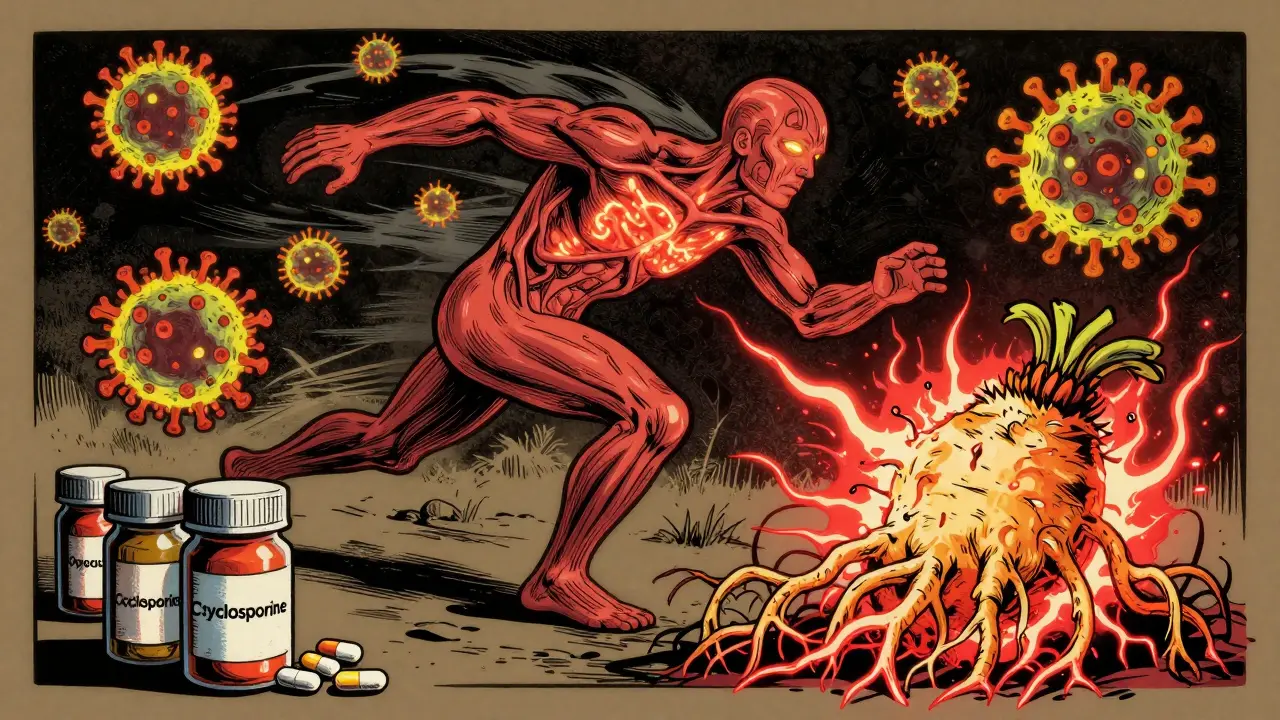
Echinacea Safety Checker
Are Echinacea Safe for You?
Safe Option
You're not taking immunosuppressants, so echinacea is unlikely to cause dangerous interactions with your medications. However, long-term echinacea use may still suppress immune function. Always discuss supplements with your healthcare provider.
Dangerous Interaction
Echinacea is NOT safe for you if you're taking immunosuppressants. The combination can cause severe complications, including organ rejection, disease flare-ups, or life-threatening blood disorders.
Stop echinacea immediately and consult your doctor or pharmacist. This interaction is well-documented and considered moderate to serious by health authorities.
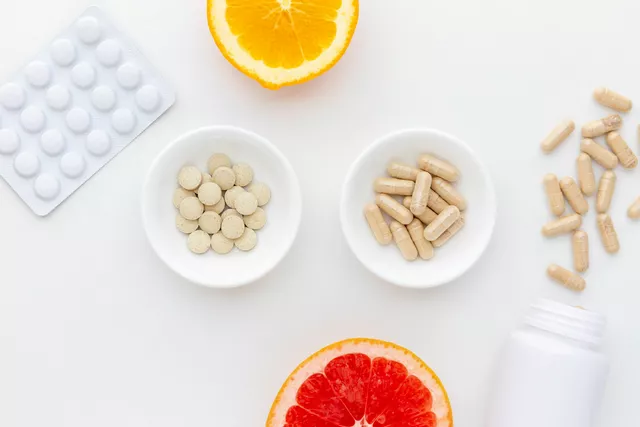
Many people turn to echinacea when they feel a cold coming on. It’s one of the most popular herbal supplements in the world, sold in capsules, teas, and tinctures with claims like "boosts immunity" or "shortens colds." But if you’re taking medication to suppress your immune system-whether after an organ transplant, for an autoimmune disease like lupus or rheumatoid arthritis, or even during cancer treatment-echinacea might be doing more harm than good.
What Echinacea Actually Does to Your Immune System
Echinacea isn’t just a simple "immune booster." Its effects are complex and change over time. In the short term, studies show it activates key immune cells: neutrophils, macrophages, and natural killer cells. These are the body’s first responders that hunt down viruses and bacteria. Alkamides in echinacea, especially isobutylamides, bind to CB2 receptors in immune tissues, triggering inflammation and cell movement. That’s why some people feel like it works-within days, their symptoms improve.
But here’s the twist: if you take echinacea for more than six to eight weeks, the effect flips. Research from the American Academy of Family Physicians and Memorial Sloan Kettering shows that long-term use can actually suppress immune activity. This dual behavior-stimulating at first, then dampening later-is what makes it so risky when mixed with prescription drugs.
What Are Immunosuppressants?
Immunosuppressants aren’t just for transplant patients. They’re used to treat autoimmune diseases where the body attacks itself. Common ones include:
- Cyclosporine
- Tacrolimus
- Azathioprine
- Mycophenolate mofetil
- Methotrexate
- Corticosteroids like prednisone
These drugs work by dialing down immune responses. For transplant recipients, this prevents organ rejection. For people with multiple sclerosis or lupus, it reduces inflammation and tissue damage. The goal is balance: keep the immune system weak enough to stop self-attack, but not so weak that it can’t fight infections.
Now imagine adding echinacea. If it’s stimulating your immune system, it’s working against the whole point of the drug. That’s not a minor concern-it’s a serious threat.
Real Cases of Dangerous Interactions
There’s no need to guess whether this interaction matters. It’s already happened.
A 55-year-old man with pemphigus vulgaris-a rare autoimmune skin disease-was stable on immunosuppressants. After starting echinacea for a cold, his skin lesions worsened dramatically. His doctors had to increase his drug dose, and even then, he only reached partial remission.
A 61-year-old lung cancer patient on chemotherapy developed severe low platelets (thrombocytopenia) after adding echinacea. The timing matched perfectly. When he stopped it, his counts rebounded.
And a 32-year-old man developed thrombotic thrombocytopenic purpura (TTP), a rare and deadly blood disorder, shortly after using echinacea for a respiratory infection. He was on immunosuppressants for an autoimmune condition. Doctors linked the episode directly to the supplement.
These aren’t isolated stories. A 2021 survey of over 500 transplant patients found that 34% had taken echinacea after surgery. Of those, 12% reported complications their doctors suspected were tied to herbal use. And in patient forums, dozens have described sudden rejection symptoms, increased medication doses, or hospitalizations after starting echinacea.
Why This Isn’t Just Theoretical
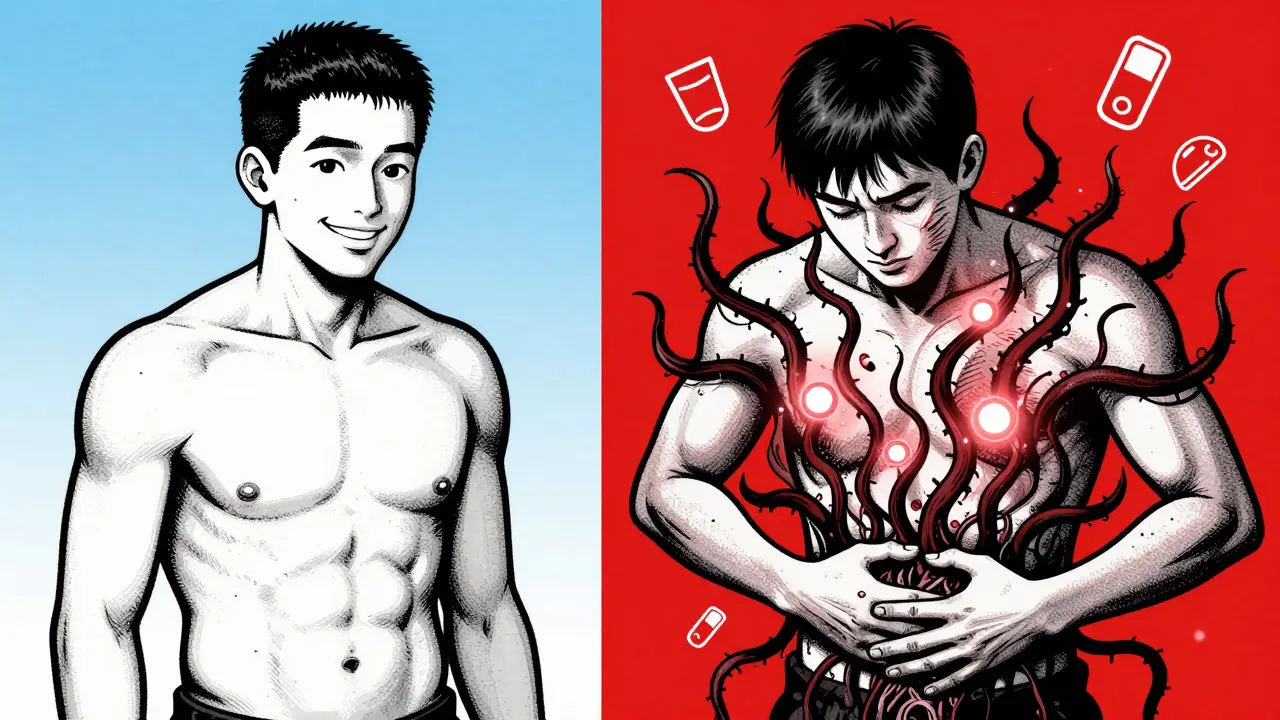
Some argue: "There aren’t enough large studies to prove this." But medicine doesn’t wait for perfect data when the risk is clear. The American Society of Health-System Pharmacists classifies this interaction as "moderate"-meaning it’s serious enough to avoid. The European Medicines Agency and the FDA both warn that echinacea may interfere with immunosuppressants.
Even the National Center for Complementary and Integrative Health (NCCIH), which often takes a neutral stance on herbs, explicitly lists echinacea-immunosuppressant interactions as a primary safety concern.
Compare this to other supplements. Milk thistle affects liver enzymes, but doesn’t touch immune cells. Ginger has mild anti-inflammatory effects but doesn’t activate macrophages. Echinacea is different. It directly targets the same pathways that immunosuppressants are trying to quiet.
Who’s at the Highest Risk?
You’re at greatest risk if:
- You had a kidney, liver, heart, or lung transplant
- You’re being treated for lupus, rheumatoid arthritis, Crohn’s disease, or multiple sclerosis
- You’re on chemotherapy or have a weakened immune system
- You’re taking more than one immunosuppressant
Even if you feel fine, your immune system might be barely holding the line. A small nudge from echinacea could tip the balance. And because these drugs have narrow therapeutic windows, even small changes in immune activity can lead to rejection, flare-ups, or infection.
What the Experts Say
The American Society of Transplantation issued a clear guideline in 2020: avoid echinacea completely in all solid organ transplant recipients. By 2022, 87% of transplant centers in the U.S. had adopted this rule.
The American College of Rheumatology updated its 2023 guidelines to say: "Patients on immunosuppressive therapy for autoimmune diseases should avoid echinacea due to potential reduction in medication efficacy." A survey of rheumatologists found 92% agreed with this stance.
And it’s not just doctors. The FDA sent warning letters to three supplement makers in 2023 for selling echinacea products without disclosing interaction risks. The National Institutes of Health is currently funding a $2.4 million study to measure how echinacea affects tacrolimus levels in kidney transplant patients-results expected in mid-2025. But you don’t need to wait for those results. The evidence already points one way.
What You Should Do
If you’re on immunosuppressants:
- Stop taking echinacea immediately-even if you think it "helped" your cold.
- Tell your doctor or pharmacist about every supplement you take. Even "natural" ones.
- Don’t assume "it’s just a herb" means it’s safe. Herbs can be powerful-and dangerous.
- Ask for alternatives. Zinc, vitamin D, and good sleep are safer ways to support immunity.
If you’re not on immunosuppressants but take echinacea regularly, consider this: long-term use may be suppressing your immune system instead of boosting it. There’s no proven benefit for preventing colds beyond the first few days of use. And if you ever start a medication that lowers your immune response, you’ll be at risk.
The Bigger Picture
The global echinacea market made $142 million in 2022. Nearly half of users take it for "immune support." But that marketing message ignores the science. What’s sold as a natural remedy can be a silent threat to people already on fragile medical regimens.
It’s not about fear. It’s about awareness. The same people who carefully track their medication doses often don’t think twice about a herbal tea or capsule. But when your immune system is being held in check by powerful drugs, even small, well-intentioned changes can have big consequences.
There’s no substitute for talking to your doctor. But if you’re on immunosuppressants, the safest choice is simple: skip echinacea.
Pankaj Gupta
March 1, 2026 AT 15:56Echinacea's dual-phase immune modulation is a fascinating example of how natural compounds can have paradoxical effects. The CB2 receptor binding mechanism is well-documented in immunopharmacology literature, and the transition from stimulation to suppression after 6–8 weeks aligns with receptor downregulation patterns seen in other phytochemicals. This isn't just anecdotal-it's a pharmacokinetic reality that deserves more attention in public health messaging.
For clinicians, the real challenge is patient education. Many assume 'natural' equals 'safe,' but the dose-response curve of echinacea is non-linear and context-dependent. The fact that 34% of transplant patients still use it speaks to a systemic failure in communication, not patient negligence.
Renee Jackson
March 1, 2026 AT 23:26Thank you for this meticulously researched and vital piece of information. As a healthcare professional, I cannot emphasize enough how critical it is to recognize that herbal supplements are not exempt from pharmacological interactions. Echinacea's mechanism of action directly conflicts with the delicate balance maintained by immunosuppressive regimens.
Every patient I counsel on these medications receives a printed handout on herb-drug interactions, and echinacea is always at the top of the list. The consequences of non-compliance are not theoretical-they are life-altering, and sometimes fatal. This article should be required reading for all patients on immunosuppressants.
RacRac Rachel
March 2, 2026 AT 00:10Yessss this is SO important!! 🙌 I’ve seen so many people on Reddit say ‘I took echinacea for 3 months and felt amazing!’-but they never mention they’re on prednisone or methotrexate 😬
My cousin had a kidney transplant and her doc literally banned her from all ‘immune boosters’-even garlic pills. She thought it was overkill until she got sick after trying a ‘natural cold remedy’ and ended up in the hospital. Now she’s an advocate. 🙏
Also-zinc and sleep are the real MVPs. No magic herb needed 💪💤
Jane Ryan Ryder
March 3, 2026 AT 05:30Callum Duffy
March 4, 2026 AT 10:03This is a profoundly important contribution to public health discourse. The complexity of echinacea’s pharmacological profile-particularly its biphasic action-underscores the necessity for nuanced understanding in clinical practice.
It is troubling that regulatory agencies have not mandated clearer labeling on over-the-counter herbal products. The absence of mandatory interaction warnings reflects a broader systemic neglect of complementary medicine’s risks, despite their widespread use.
One must question whether the commercial interests of the supplement industry have outpaced the ethical imperatives of patient safety.
Chris Beckman
March 6, 2026 AT 04:10Levi Viloria
March 7, 2026 AT 02:32As someone raised in a culture where herbal medicine is deeply woven into daily life, I’ve seen both the power and the peril of botanicals. In my grandmother’s village, echinacea was used sparingly-never for more than a week, never with other medicines.
The modern global market has stripped these traditions of their wisdom. What was once a ritual of restraint has become a mass-market product with no cultural context. We’ve lost the art of knowing when not to use something.
This isn’t just about science-it’s about cultural erosion. The answer isn’t to abandon herbs, but to restore their place within disciplined, informed practice.
Richard Elric5111
March 8, 2026 AT 07:09The epistemological dilemma presented by echinacea reveals a deeper tension in modern medicine: the conflict between empirical reductionism and holistic phenomenology.
While pharmacological models isolate molecular pathways, human experience resists such compartmentalization. The patient who reports subjective improvement may not be deluded-rather, they are responding to a transient immunomodulatory effect that is statistically significant yet clinically insignificant in the context of chronic immunosuppression.
Thus, the ethical imperative is not merely to warn, but to illuminate: the body’s perception of benefit does not equate to systemic safety. Truth, in this domain, is not subjective-it is physiological.
Betsy Silverman
March 9, 2026 AT 11:17Thank you for writing this. I’m a nurse who works with transplant patients, and I can’t tell you how many times I’ve had to explain why ‘just one cup’ of echinacea tea isn’t harmless.
One man told me, ‘But it’s just a plant-it can’t do that much.’ I showed him the graph of tacrolimus levels dropping 40% after 7 days of echinacea use. He didn’t speak for the rest of the appointment.
People need to understand: when your immune system is on life support, you don’t get to experiment with herbal ‘boosters.’
Also-thank you for mentioning zinc and sleep. Those are the real heroes.
Jeff Card
March 10, 2026 AT 03:11I’ve been on azathioprine for Crohn’s for 12 years. I used to take echinacea every fall because I thought it helped. I never had a flare, so I figured it was fine.
Then last year, I got a bad flu, took echinacea again, and two weeks later, I was hospitalized with a severe infection. My doctor said my immune system was too active-probably because of the supplement.
I stopped everything. No herbs. No ‘natural’ stuff. Just meds, rest, and good food. I haven’t had a flare since.
It’s not about being scared. It’s about respecting what your body is doing. Sometimes, less is more.
Matt Alexander
March 10, 2026 AT 14:24Simple truth: if you’re on medicine to calm your immune system, don’t give it a party. Echinacea is like throwing gasoline on a fire you’re trying to put out.
Don’t listen to influencers. Don’t trust ‘all-natural’ labels. Your doctor isn’t trying to control you-they’re trying to keep you alive.
Zinc, vitamin D, water, sleep. That’s all you need. No tea required.
Sharon Lammas
March 11, 2026 AT 02:45There’s a quiet tragedy in how we treat medicine. We’ve created a culture where science is optional if it conflicts with desire. The belief that ‘nature knows best’ is not wisdom-it’s romantic ignorance.
Echinacea’s biphasic effect isn’t mysterious. It’s predictable. And predictable things can be controlled-if we choose to respect them.
What’s tragic is not the supplement industry, but the fact that people would rather believe in a myth than trust the evidence that could save their lives.
Knowledge without action is just noise.
marjorie arsenault
March 12, 2026 AT 03:59I’ve been a rheumatology patient for 15 years. I used to take echinacea every time I felt a sniffle. I thought I was being proactive.
Then I had a flare so bad I couldn’t hold a spoon. My rheumatologist sat me down and said, ‘You’re not fighting your cold-you’re fighting your medication.’
I stopped. I haven’t taken a single herb since. And guess what? My flares are fewer, milder, and I feel more in control.
You don’t need to ‘boost’ your immune system. You need to protect it. That’s the real gift of awareness.
Deborah Dennis
March 13, 2026 AT 12:06