
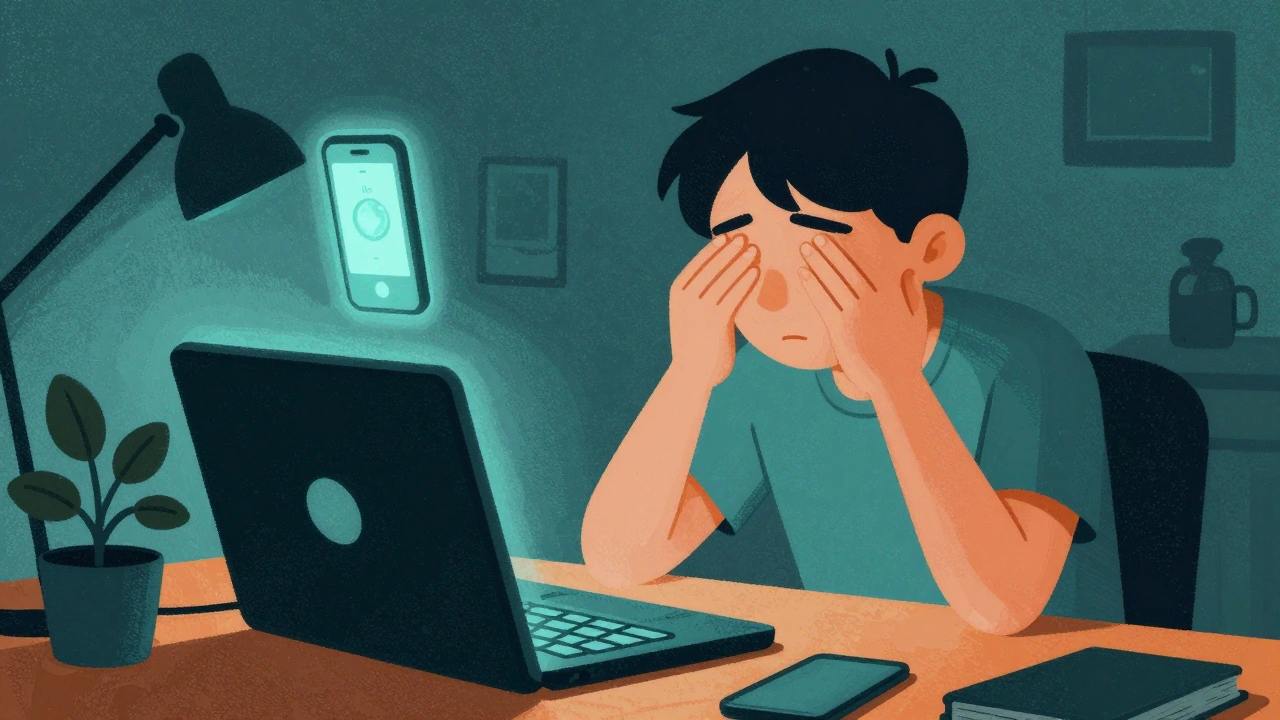
How many times have you rubbed your eyes after a long day staring at your phone, laptop, or tablet? If you’re like most people, it’s more than you’d like to admit. By 2023, the average person spent nearly 7 hours a day looking at screens. That’s more time than most of us spend sleeping. And while we’ve all heard that blue light is bad for our eyes, the truth is messier than the marketing claims. Some experts say it’s harmless. Others warn of permanent damage. So what’s really going on - and what should you actually do?
What Exactly Is Blue Light, and Why Does It Matter?
Blue light isn’t just the glow from your phone. It’s a specific part of the visible light spectrum, between 415 and 455 nanometers, with high energy that can reach deep into your eye. Unlike red or yellow light, blue light doesn’t focus cleanly on the retina. Instead, it scatters slightly, forcing your eyes to work harder to keep things sharp. That’s one reason why your eyes feel tired after hours of screen time.
It’s not just about strain. This short-wavelength light triggers chemical reactions in your cornea and retina. A 2018 NIH study found that exposure to 450 nm blue light at moderate intensity reduced human corneal cell viability by 37%. Another study showed a 218% spike in reactive oxygen species - harmful molecules that cause oxidative stress - within just 30 minutes of exposure. These aren’t theoretical risks. They’re measurable biological responses.
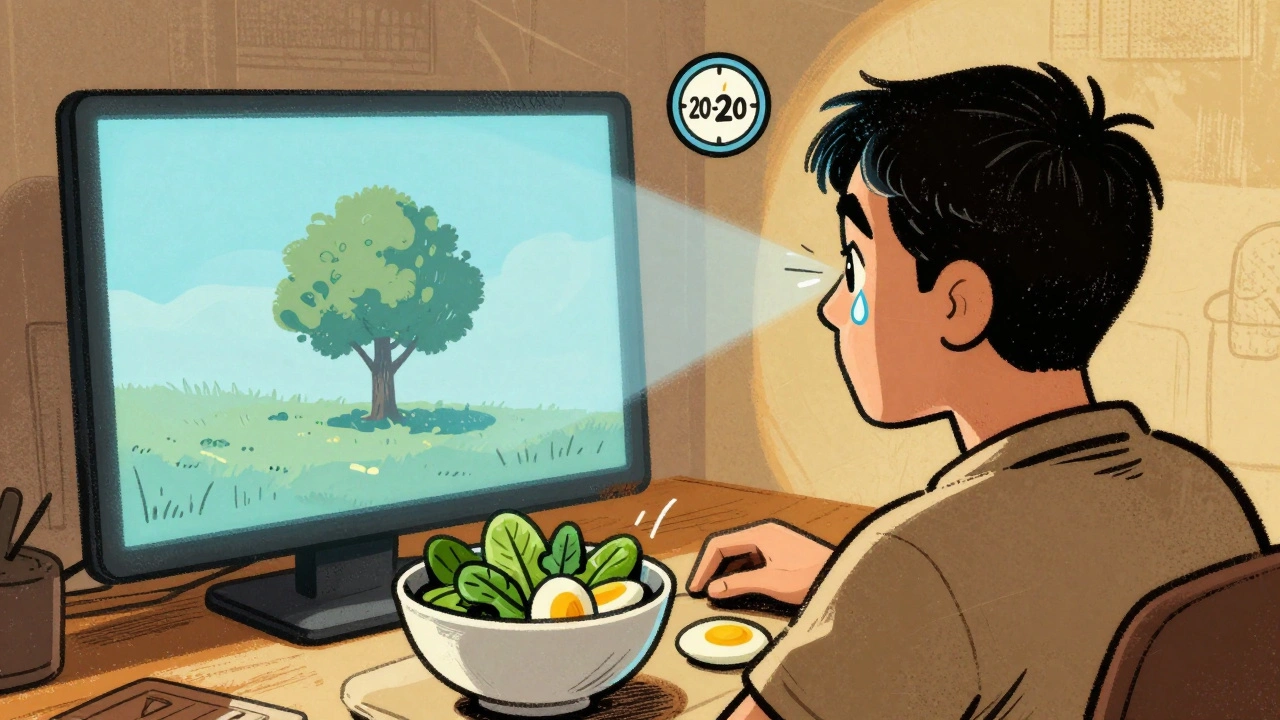
But here’s the twist: your eyes have natural defenses. Lutein and zeaxanthin, pigments found in leafy greens and eggs, build up in the macula - the central part of your retina - and act like internal sunglasses. A 2024 study in Nature Communications showed that taking 10 mg of lutein and 2 mg of zeaxanthin daily increased this natural filter by 0.12 optical density units, roughly equal to blocking 25% of blue light. Your body already has tools. The question is whether you’re feeding them.
The Blue Light Glasses Debate: Do They Help or Just Look Weird?
Walk into any optometrist’s office or scroll through Amazon, and you’ll see hundreds of blue light glasses. Clear lenses with a faint coating. Amber-tinted frames marketed for night use. Some claim to block 90% of blue light. But here’s what the data says:
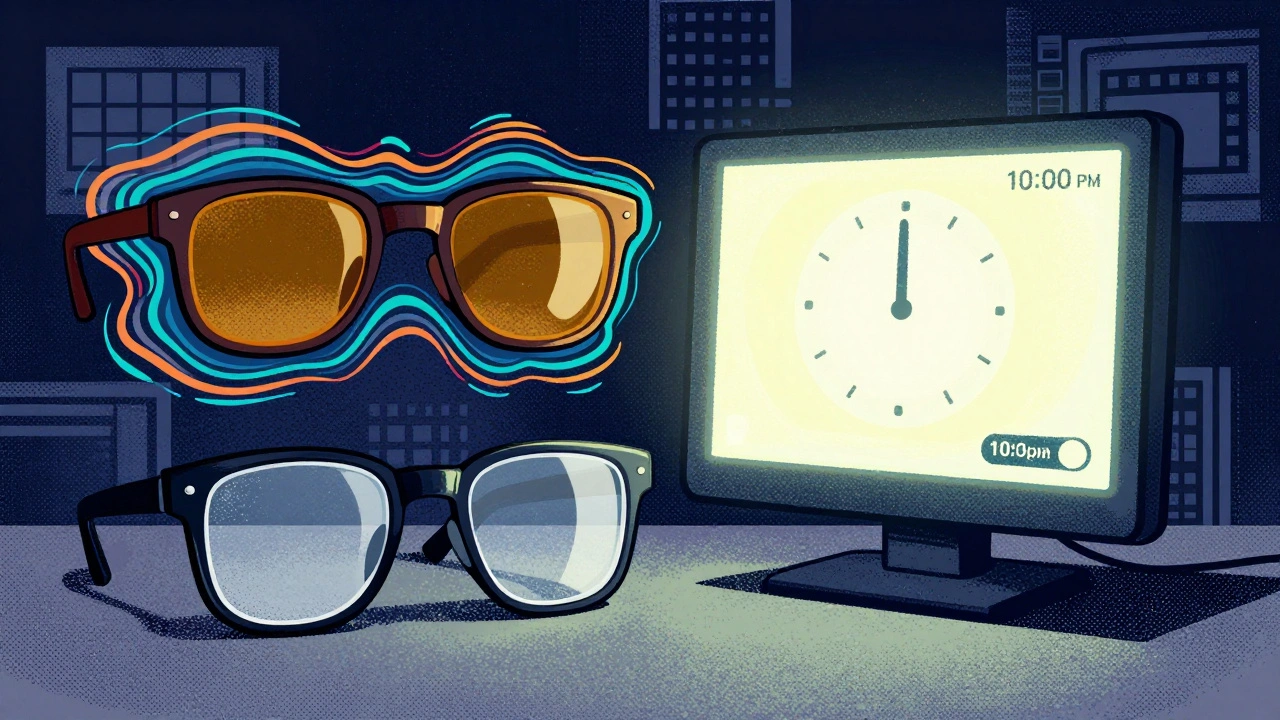
- Amber-tinted glasses block 65-100% of blue light in the 400-500 nm range - but they also distort colors. One University of Manchester study found they reduced visual acuity by 8.3% in tasks requiring color accuracy, like graphic design or photography.
- Clear blue-light-filtering lenses, like Essilor’s Eyezen, claim to block 20% of blue light. Independent testing by Consumer Reports in March 2023 found they only blocked 12%. That’s not nothing, but it’s far less than advertised.
- Software filters like Night Shift or f.lux reduce blue light by 10-20%. But they miss the most damaging range - 415-455 nm - according to the International Commission on Illumination. They’re better than nothing, but not a full solution.
And then there’s the social cost. On GlassesUSA.com, 29% of negative reviews mention feeling awkward wearing amber lenses at work. Photographers on DPReview forums flat-out reject them. One user wrote: “The color shift ruins my ability to assess skin tones.” If your job depends on color accuracy, these glasses might do more harm than good.
So are they worth it? For most people, not unless you’re using them at night. Their real benefit isn’t protecting your retina - it’s helping your sleep.
Blue Light and Sleep: The Real Crisis
If you’ve ever tossed and turned after scrolling in bed, you’re not imagining it. Blue light doesn’t just stress your eyes - it hijacks your body clock.
Harvard Medical School research from 2011-2015 showed that 6.5 hours of 6500K blue light suppressed melatonin - the sleep hormone - for 105 minutes. Compare that to green light, which only suppressed it for 52 minutes. Blue light shifted circadian rhythms by 3 hours. Green light? Just 1.5.
That’s why sleep experts don’t care whether blue light causes macular degeneration. They care that it’s keeping you up. A 2018 University of Toronto study found that turning on night mode two hours before bed increased melatonin production by 58%. That’s not a minor tweak - it’s the difference between falling asleep in 20 minutes or lying awake for two hours.
Apple’s iOS 17.4 (March 2024) introduced adaptive color temperature, which adjusts blue light based on ambient light sensors. Independent tests showed it reduced melatonin suppression by 37% compared to older Night Shift. That’s progress. But only if you turn it on - and leave it on.
Here’s the catch: 68% of people who try to use night mode fail because they turn it on for their phone but forget their tablet, monitor, or TV. Inconsistent use cancels out the benefit. Set it once. Leave it on. Make it automatic.
The 20-20-20 Rule: The Only Evidence-Based Fix
Forget expensive glasses. The single most effective thing you can do for digital eye strain is the 20-20-20 rule: every 20 minutes, look at something 20 feet away for 20 seconds.
It’s not a myth. A 2021 study in Optometry and Vision Science found it reduced reported eye strain by 53.7%. Why? Because it gives your focusing muscles a break. When you stare at a screen, your eyes are locked in near-focus mode. That’s like holding a bicep curl for eight hours straight. Eventually, your muscles cramp.
And it’s not just about fatigue. A 2023 Reddit survey of 1,243 users found 78% felt less strain after using the rule. 63% reported better sleep. No glasses. No filters. Just a simple habit.
Set a timer. Use an app. Stick a sticky note on your monitor. Do whatever it takes. This isn’t optional - it’s the only intervention with strong, repeatable evidence.
Other Habits That Actually Make a Difference
There are three more simple changes that have real impact:
- Match your screen brightness to your surroundings. If your room is dim, your screen shouldn’t be blinding. The Lighting Research Center found that adjusting brightness to match ambient light (ideally 300-500 lux) cut discomfort by 41%.
- Keep your screen at arm’s length. The American Optometric Association recommends 20-30 inches from your eyes. At 12 inches, your eyes are working 3.7 diopters harder than they should. That’s like lifting a 10-pound weight with one hand for hours.
- Use artificial tears if your eyes feel dry. Digital eye strain causes dry eyes in 64.7% of users, according to WebMD. Blinking less while staring at screens reduces tear film coverage. Lubricating drops help - but only if you use them regularly. Don’t wait until it hurts.
And yes, nutrition matters. Lutein and zeaxanthin aren’t magic pills, but they’re the closest thing to a natural blue light filter. Eat spinach, kale, eggs, corn, and orange peppers. Or take a daily supplement. Either way, support your eyes from the inside out.
What About the Experts? Why So Much Confusion?
It’s confusing because the science isn’t settled - and because different people are studying different things.
Dr. Martin Rosenberg, lead author of the 2018 NIH review, says blue light between 415-455 nm is “closely related to eye light damage” and can contribute to dry eye, cataracts, and macular degeneration. But the American Academy of Ophthalmology says there’s “no scientific evidence” that blue light from screens harms your eyes. So who’s right?
They both are - in different contexts. The NIH study looked at lab conditions: high-intensity blue light on isolated cells. The AAO is talking about real-world screen use: low-intensity, intermittent exposure over hours. The European Food Safety Authority says exposure under 10,000 lux for less than 8 hours is safe. The French health agency warns about children under 3 exposed to over 100 lux. Context changes everything.
The real consensus? Screen blue light won’t blind you. But it can make your eyes ache, dry out, and mess with your sleep. That’s enough reason to act - even if it’s not a medical emergency.
What’s Next? The Future of Blue Light Protection
The market for blue light products hit $3.12 billion in 2022 and is projected to grow to over $9 billion by 2030. But the tide is turning.
Display manufacturers are building blue light reduction into screens. OLED panels now reduce 415-455 nm emission by 30-40% without software filters. Samsung’s 2025 roadmap targets 50% reduction with less than 2% color shift. Quantum dot lenses in development can selectively filter blue light without distorting colors.
That means the future isn’t about buying glasses - it’s about buying better screens. By 2028, IDC predicts non-prescription blue light glasses will decline 18% annually as hardware solutions take over.
Meanwhile, the FDA cleared Lumineyes in 2023 - the first medical device designed to correct circadian disruption with filtered white light. It’s not for everyone, but it shows the field is evolving beyond consumer gimmicks.
What Should You Actually Do?
Here’s your simple, no-fluff plan:
- Turn on night mode on all devices - phone, tablet, laptop, TV - two hours before bed.
- Follow the 20-20-20 rule religiously. Set a reminder if you have to.
- Keep your screen 20-30 inches away and adjust brightness to match your room.
- Eat more leafy greens and eggs, or take lutein and zeaxanthin daily.
- If you have dry eyes, use preservative-free artificial tears twice a day.
- Don’t waste money on blue light glasses unless you’re using them at night and you’re okay with yellow-tinted vision.
You don’t need to eliminate screens. You just need to use them smarter.
Do blue light glasses really protect your eyes from damage?
There’s no strong evidence that blue light from screens causes permanent eye damage like macular degeneration. The American Academy of Ophthalmology states there’s no scientific proof of harm. Blue light glasses may help with eye strain and sleep, but they don’t prevent retinal damage. Their main benefit is reducing blue light at night to support melatonin production.
Is the 20-20-20 rule effective?
Yes. A 2021 study in Optometry and Vision Science showed it reduced digital eye strain by 53.7%. It works because it gives your eye muscles a break from constant focusing on close objects. It’s simple, free, and backed by data. Set a timer if you need to.
Should I use blue light filters on my phone at night?
Yes, especially if you have trouble falling asleep. Blue light suppresses melatonin, the hormone that tells your body it’s time to rest. Turning on night mode two hours before bed can increase melatonin by 58%. Make sure it’s turned on across all your devices - phone, tablet, laptop - for the best results.
Can blue light cause dry eyes?
Yes. When you stare at screens, you blink 66% less than normal. That causes your tear film to evaporate faster, leading to dry, gritty, or watery eyes. About 64.7% of users report dry eye symptoms from screen use. Using artificial tears and remembering to blink consciously can help.
Are expensive blue light glasses worth it?
For most people, no. Independent tests show many clear blue light lenses block only 12% of blue light, not the 20% or more claimed. Amber-tinted glasses block more but distort colors and can interfere with work. If you’re using them at night to improve sleep, they might help - but the 20-20-20 rule and night mode are cheaper and better proven.
What’s the best way to reduce blue light exposure?
Use a combination of habits: turn on night mode two hours before bed, follow the 20-20-20 rule, keep your screen at arm’s length, adjust brightness to match your room, and eat foods rich in lutein and zeaxanthin. These steps address both eye strain and sleep disruption - the two real problems with blue light.
Brian Perry
December 4, 2025 AT 06:53Stacy Natanielle
December 6, 2025 AT 06:48kelly mckeown
December 8, 2025 AT 04:32Tom Costello
December 8, 2025 AT 04:39Wendy Chiridza
December 9, 2025 AT 03:01Palanivelu Sivanathan
December 9, 2025 AT 06:42Adrianna Alfano
December 10, 2025 AT 17:27Casey Lyn Keller
December 10, 2025 AT 21:05Jessica Ainscough
December 12, 2025 AT 17:03May .
December 14, 2025 AT 03:23Sara Larson
December 15, 2025 AT 14:40Kevin Estrada
December 17, 2025 AT 00:07Katey Korzenietz
December 17, 2025 AT 08:20Mindy Bilotta
December 18, 2025 AT 00:54Michael Bene
December 18, 2025 AT 10:17