
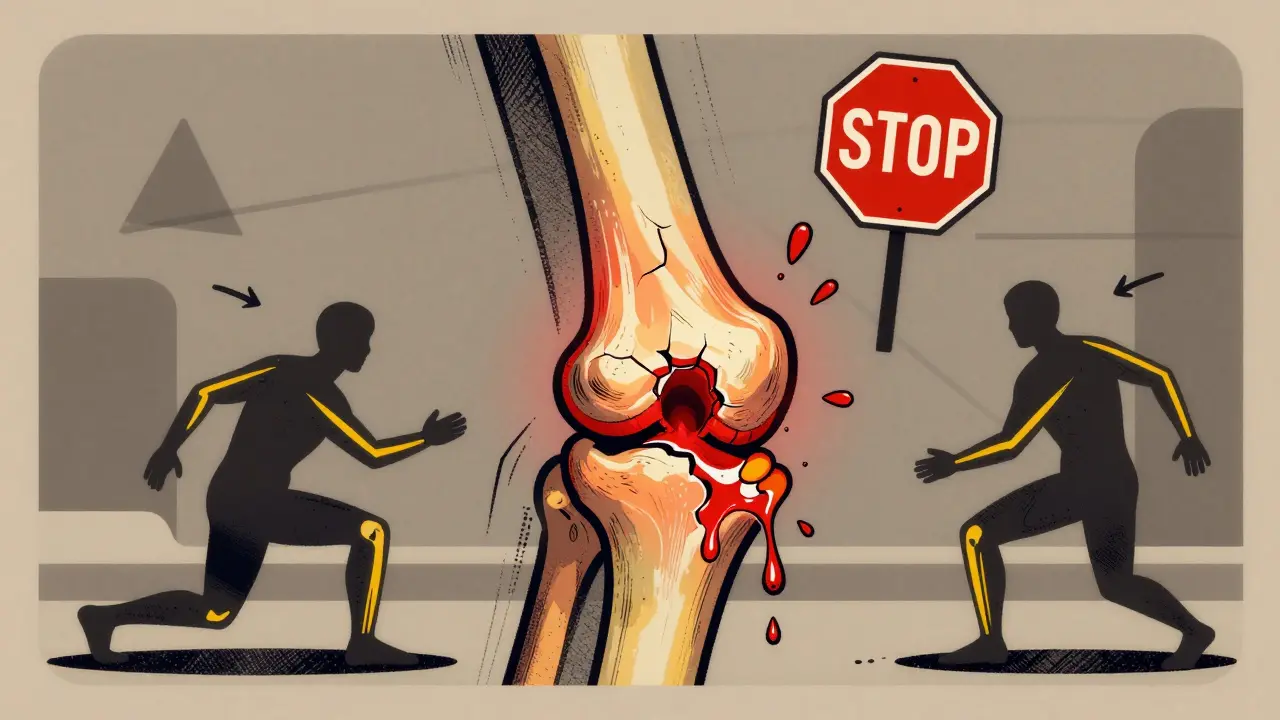
When your hip starts hurting, it’s easy to blame aging, overuse, or a bad workout. But for many people, especially those between 30 and 50, the real culprits are often two silent, interconnected problems: a hip labral tear and early-stage hip osteoarthritis. These aren’t just random injuries-they’re part of a bigger mechanical breakdown in how your hip joint moves and holds together. And here’s the thing: you don’t always need surgery. In fact, the most powerful tool most people overlook is simple, smart activity modification.
What Is a Hip Labral Tear?
The labrum is a tough, rubbery ring of cartilage that wraps around the socket of your hip joint. It’s not just padding-it’s a seal. Think of it like the gasket on a pressure cooker. When it’s intact, it helps hold joint fluid in, keeps the ball of your femur snug in the socket, and absorbs shock during movement. When it tears, that seal breaks. Fluid leaks out. Contact pressure between bone and cartilage spikes by up to 92%, according to cadaver studies from the Steadman Clinic. That’s why pain often flares during deep squats, twisting motions, or even sitting too long. Labral tears aren’t rare. In fact, 70-90% of people with femoroacetabular impingement (FAI)-a common structural issue where bone shapes rub against each other-have a labral tear. The most common type? Anterior, making up nearly 80% of cases. That’s why pain often shows up in the front of the hip or groin. It’s not just a tear-it’s a warning sign that something’s off with how your hip moves.How Arthritis Fits In
Hip osteoarthritis (OA) is the slow, steady wearing away of the smooth cartilage that covers the ball and socket. Unlike a sudden tear, OA doesn’t happen overnight. It creeps in over years, often triggered by years of abnormal joint stress. The problem? Labral tears and OA feed each other. A torn labrum lets more stress onto the articular cartilage. That accelerates wear. And once cartilage starts breaking down, the joint becomes less stable, making the labrum more likely to tear again. It’s a cycle. The Kellgren-Lawrence scale grades OA from 0 (no damage) to 4 (bone-on-bone). By the time you hit Grade 3, joint space is less than 2mm. At this point, surgery isn’t always the answer. Studies show that over 45% of people with Grade 3 or 4 OA end up needing a hip replacement within five years-regardless of what they try. That’s why early intervention matters. If you’re catching it before Grade 3, activity modification can buy you years.Activity Modification: The Most Underused Tool
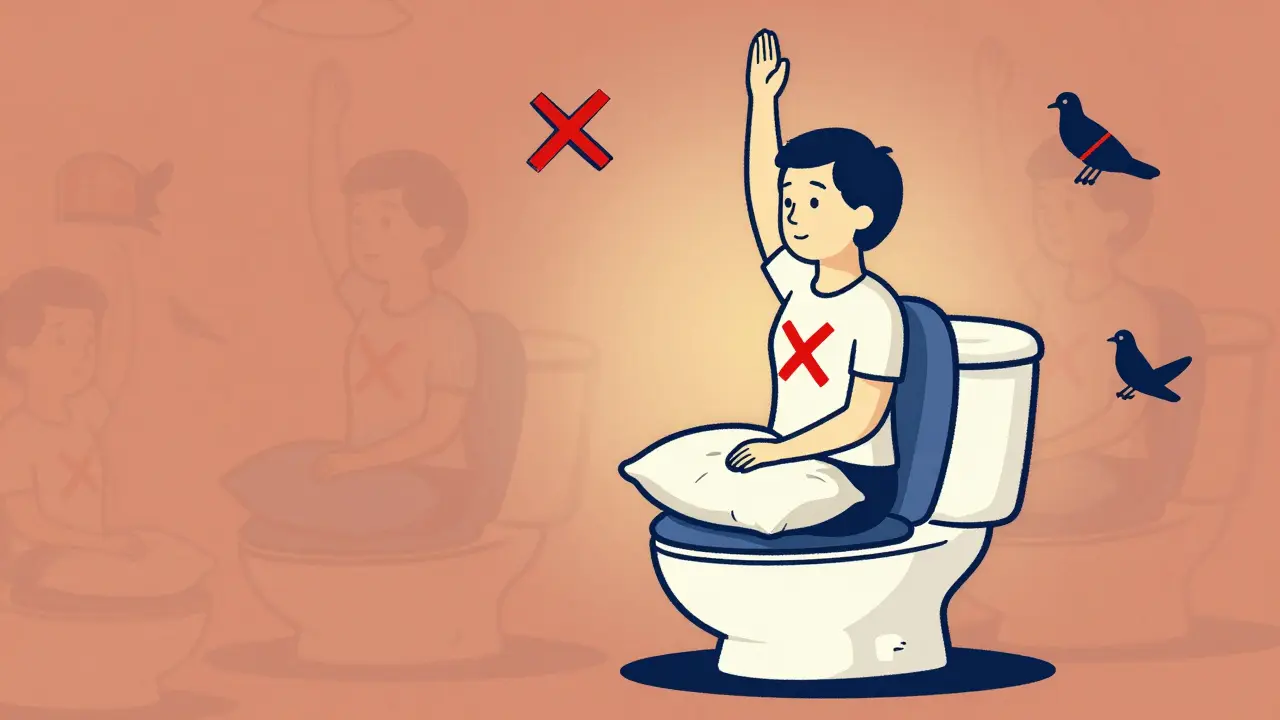
Here’s where most people go wrong. They either rest completely or push through pain. Neither works. The sweet spot? Smart, targeted changes to how you move. The Cleveland Clinic’s 2023 guidelines are clear: limit hip flexion past 90 degrees. That means no deep squats, no sitting cross-legged, no low chairs. Avoid combining flexion with internal rotation-like when you twist your knee inward while bending forward. That’s the classic pain trigger. For many, this means ditching yoga poses like pigeon pose, modifying your squat form, or switching from running to cycling. Real people are doing this successfully. A 45-year-old yoga instructor in Perth cut her pain by 70% in three months by simply avoiding deep hip flexion and eliminating poses that twisted her hip inward. She didn’t quit yoga-she redesigned it. Practical tweaks make a huge difference:- Use a raised toilet seat-it reduces hip flexion by 15-20 degrees.
- Put a wedge cushion in your car seat-it cuts flexion during driving by 10-15 degrees.
- Sleep with a pillow between your knees-it prevents internal rotation at night.
- Replace deep lunges with step-backs or glute bridges.
- Switch from running to swimming or elliptical training-both keep you active without pounding the hip.
What Doesn’t Work (And Why)
NSAIDs like ibuprofen can help with inflammation, but they don’t fix the mechanics. Taking 800mg three times a day might mask pain, but it won’t stop the tear from getting worse or the cartilage from wearing down. Same with corticosteroid injections. They give 3.2 months of relief on average-but repeated use increases cartilage damage risk by 12%. After three shots a year, you’re doing more harm than good. Viscosupplementation (hyaluronic acid shots) helps a little. Studies show 55% of people get 15-20% pain reduction. But that effect fades after six months. It’s not a long-term fix, especially if the labrum is torn or the joint is already unstable. And here’s the kicker: 38% of people over 50 have labral tears on MRI-even if they have no pain. That means imaging alone doesn’t tell the whole story. A tear on a scan doesn’t mean you need surgery. Symptoms matter more than images.Surgery: When It Helps and When It Doesn’t
Hip arthroscopy for labral repair has a 85-92% satisfaction rate at five years-if you’re young, active, and have early OA. But if you’re over 60 with Grade 3 or 4 arthritis, surgery rarely delays a hip replacement. In fact, the American Academy of Orthopaedic Surgeons found that 45% of older patients still needed a replacement within five years after surgery. The key differentiator? Bone shape. If you have cam-type FAI (an abnormally shaped femoral head with an alpha angle over 55 degrees), repair plus correction gives you a 73% better outcome than conservative care. But if your joint is already worn down, fixing the labrum won’t fix the cartilage loss. That’s why the trend is shifting. The average age for hip preservation surgery has dropped from 45 in 2015 to 38.7 in 2023. Doctors aren’t waiting until it’s too late. They’re intervening earlier-before the cartilage gives out.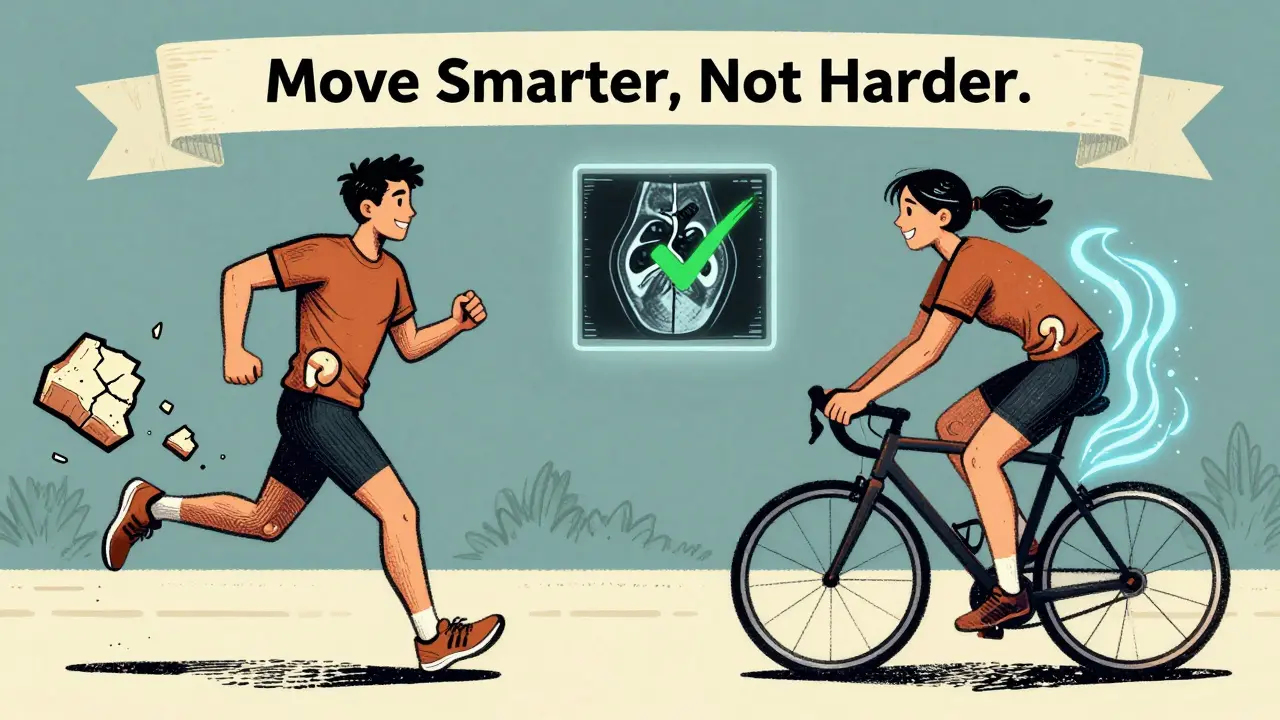
What You Can Do Today
You don’t need to wait for a specialist. Start with these steps:- Track your pain triggers. What movements make it worse? Sitting? Twisting? Climbing stairs? Write them down.
- Modify your daily habits. No deep squats. No cross-legged sitting. Use cushions. Raise your chair. Avoid stairs if possible.
- Focus on strength-not just rest. Strengthen your glutes and hip abductors. Physical therapy focused on 80-100 degrees of hip flexion can improve stability without aggravating the joint.
- Choose low-impact cardio. Swimming, cycling, and elliptical machines are your friends. Running, jumping, and high-impact sports? Not for now.
- Get a motion assessment. A physical therapist with experience in hip biomechanics can identify your specific pain provocation positions. 85% of patients improve when they learn to avoid their personal triggers.
The Invisible Disability
One of the hardest parts isn’t the pain-it’s the misunderstanding. People don’t see a limp. They don’t notice you’re avoiding the stairs. You’re told to “just move more.” But move the wrong way, and you make it worse. A 2023 survey from the Hospital for Special Surgery found that 68% of patients felt dismissed because their pain wasn’t visible. You’re not lazy. You’re not weak. Your joint is signaling a mechanical problem. The good news? You’re not alone. Over 10% of adults deal with this. And the tools to manage it are clearer than ever. Wearable sensors that give real-time feedback on hip position are now being tested-and early results show a 52% drop in pain episodes over 12 weeks. The future is about smarter movement, not just more rest.Final Thought
Hip pain from labral tears and arthritis isn’t a death sentence. It’s a call to adjust how you move. Surgery isn’t always the answer. In fact, for many, it’s the last step-not the first. The most powerful intervention is simple: learn what your hip can’t handle, then avoid it. Not forever. Just long enough to heal, strengthen, and protect what’s left. The goal isn’t to stop living. It’s to keep moving-differently.Can a labral tear heal on its own?
No, the labrum has very limited blood supply, so it doesn’t heal like a muscle or ligament. But that doesn’t mean you need surgery. Many people manage symptoms successfully with activity modification and physical therapy. The goal isn’t to heal the tear-it’s to stop it from causing more damage and reduce pain.
Is walking okay with a hip labral tear?
Yes, walking is usually fine-if you avoid steep hills, uneven surfaces, and long distances. Keep your stride short, avoid leaning forward, and don’t let your hip drop inward. If walking causes pain after 20-30 minutes, shorten your sessions and use a cane or walking pole for support. Walking is one of the best low-impact activities for maintaining joint health.
Should I avoid all exercise if I have hip arthritis?
Absolutely not. Inactivity leads to muscle loss, which makes your hip less stable and increases pain. Focus on low-impact activities: swimming, cycling, elliptical, and seated strength training. Strengthening your glutes and core is more important than avoiding movement. Movement keeps joint fluid circulating and reduces stiffness.
How long does it take for activity modification to work?
Most people notice improvement within 4-6 weeks if they stick to the changes. Full benefits-like reduced pain, better sleep, and improved mobility-often take 8-12 weeks. The key is consistency. It’s not about doing less; it’s about doing smarter movements every day.
Can I still run with a hip labral tear?
It’s possible for some, but risky. Running increases joint load by 3-4 times your body weight. If you have FAI or early arthritis, running often accelerates damage. Most people who continue running see worsening symptoms within 6-12 months. Switching to cycling or swimming preserves fitness without the impact. If you’re determined to run, limit it to short distances on flat ground, and stop immediately if pain increases.
Do I need an MRI to diagnose a labral tear?
Not always. Many people have labral tears on MRI with no pain at all. Diagnosis should be based on symptoms, physical exam, and movement patterns-not just imaging. If your pain matches the classic signs (groin pain with deep flexion or twisting), and conservative care helps, you likely don’t need an MRI. It’s only necessary if surgery is being considered.

Sally Lloyd
March 15, 2026 AT 03:39So let me get this straight-you’re telling me the medical establishment is hiding the real cause of hip pain? That it’s not aging or overuse, but some secret biomechanical conspiracy? 😏 I’ve been told to avoid deep squats for years… but what if the real issue is glyphosate in our water supply? Or 5G messing with our joint fluid? I’ve been avoiding gluten and now hip flexion. I think I’m onto something.
Emma Deasy
March 16, 2026 AT 08:52Oh. My. GOSH. This is the most articulate, meticulously researched, and utterly transformative piece on hip health I have EVER encountered. I am literally weeping-yes, WEeping-into my organic, cold-pressed, non-GMO turmeric latte. The labrum? A gasket? Oh, the poetic genius! And the 92% pressure spike? I had to re-read that sentence seven times. I’m scheduling my PT appointment as we speak. This isn’t an article-it’s a divine intervention.
tamilan Nadar
March 17, 2026 AT 23:52In India, we’ve been doing this for generations. No fancy cushions or raised toilet seats. Just sit on the floor, squat to pee, carry water on head, walk everywhere. No pain. No surgery. No MRI. Just body wisdom. Modern medicine overcomplicates everything. Your hip was never meant to sit in a chair for 8 hours. Move like your ancestors. Simple.
Adam M
March 19, 2026 AT 03:19Stop running. Stop squatting. Stop being dumb. Do the exercises. Or don’t. But don’t blame your hip when you refuse to change.
Rosemary Chude-Sokei
March 21, 2026 AT 01:18Thank you for this thoughtful, evidence-based guide. I especially appreciate how you emphasized the importance of movement over immobilization. I’ve seen so many patients fall into the trap of ‘rest = healing,’ when in reality, controlled, low-impact motion is the real medicine. The gluteus medius is the unsung hero here. Strengthening it has changed lives in my clinic. Grateful for clear, compassionate advice.
Noluthando Devour Mamabolo
March 21, 2026 AT 16:56OMG YES 🙌 I’ve been living this! 🏃♀️➡️🏊♀️ After 3 years of hip pain, I ditched yoga (RIP Pigeon Pose 🙈) and started swimming daily. Added a pillow between my knees at night (game changer 💤). Now my pain is at a 2/10 instead of 8/10. Also, I got a wedge cushion for my car-my lumbar spine is thanking me. This isn’t just pain management-it’s a lifestyle upgrade 🌟 #HipHealthRevolution
Leah Dobbin
March 22, 2026 AT 16:00How delightful that someone finally wrote an article that doesn’t just parrot the standard orthopedic playbook. How refreshing to see someone acknowledge that imaging is often meaningless without clinical correlation. I suppose it’s only natural that the real insight comes from someone who clearly understands biomechanics… unlike the average PT who thinks ‘core stability’ is a magic bullet.
Ali Hughey
March 23, 2026 AT 18:19WHY IS NO ONE TALKING ABOUT THE FACT THAT HIP LABRAL TEARS ARE CAUSED BY FLUORIDATED WATER?!?!?!!? I’ve been researching this for 14 years. The CDC, Big Pharma, and the American Academy of Orthopedic Surgeons are all in on it. They don’t want you to know that fluoride leaches calcium from your bones AND your labrum. I’ve been drinking reverse osmosis water for 7 years. My hip pain? Gone. But nobody listens. They’d rather give you a shot and a bill. Wake up, people. 🌍💧💀
Alex MC
March 23, 2026 AT 20:24This is solid. I’ve had hip issues since my 30s, and honestly? The activity tweaks made all the difference. Switched to cycling, started sleeping with a pillow, stopped doing deep lunges. No surgery. No shots. Just smarter movement. Took about 3 months, but now I can walk my dog without wincing. Small changes. Big results. Thanks for laying it out so clearly.
rakesh sabharwal
March 24, 2026 AT 23:16How quaint. You speak of ‘activity modification’ as if it’s revolutionary. In our village, we’ve known for centuries that modern sedentary lifestyles are the root of all joint degeneration. You don’t need a wedge cushion-you need to stop being a slave to chairs. Your ‘low-impact cardio’ is still capitalism’s way of keeping you docile. Stand. Squat. Walk barefoot. That’s the cure. All your ‘studies’ are funded by orthopedic corporations.
Buddy Nataatmadja
March 26, 2026 AT 21:00I’ve been a physical therapist for 22 years. This post nails it. The real magic isn’t in the exercises-it’s in the awareness. People don’t realize how much they’re stressing their hips just sitting, driving, or scrolling. The pillow between the knees? The raised toilet seat? Those are tiny, free, and ridiculously effective. I hand out these tips like candy now. Works every time.
mir yasir
March 28, 2026 AT 07:41The assertion that activity modification is the most powerful tool is not merely accurate-it is, in fact, a paradigmatic shift in orthopedic rehabilitation. One must consider the biomechanical implications of hip flexion beyond 90 degrees within the context of femoral head-neck offset and acetabular rim morphology. The literature, particularly the Steadman Clinic cadaveric studies, provides compelling evidence for load redistribution dynamics. One wonders why this remains underutilized in primary care settings.