
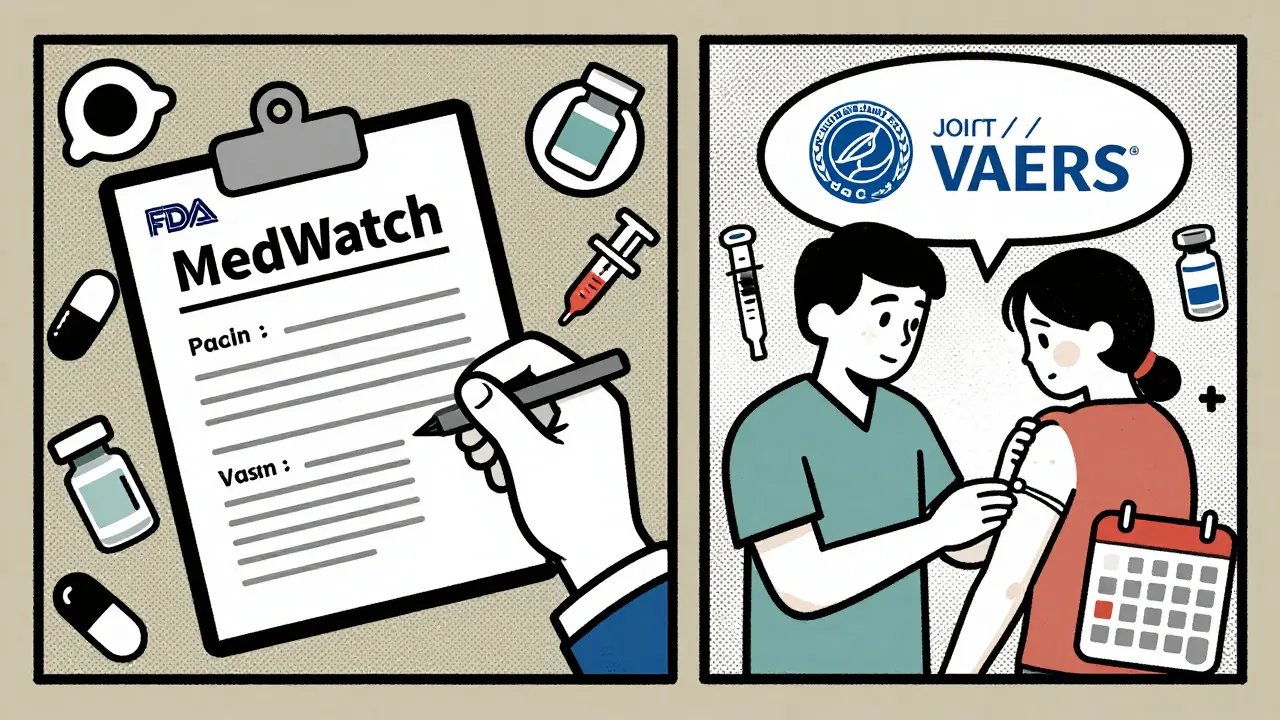
MedWatch vs VAERS Reporting Checker
Which Reporting System Should You Use?
This tool helps you determine whether to report a reaction to MedWatch (for drugs, devices, supplements) or VAERS (for vaccines).
Every year, millions of people take prescription drugs or get vaccinated. Most have no issues. But some don’t. When something goes wrong, how does the government find out? And how do they decide if it’s a real problem or just a coincidence? That’s where MedWatch and VAERS come in. They’re two separate systems, both run by U.S. health agencies, but they track completely different things. Confusing them is common-and dangerous. If you report a vaccine reaction to MedWatch, it won’t get seen. If you report a bad reaction to a blood pressure pill to VAERS, it won’t be counted. Getting this right matters.
What is MedWatch?
MedWatch is the FDA’s system for tracking problems with almost every medical product you can think of-except vaccines. That includes prescription drugs, over-the-counter medicines, medical devices like pacemakers or insulin pumps, dietary supplements, and even tobacco products. If you’re a doctor, pharmacist, or patient and you notice something unusual after taking a medication or using a device, you can report it through MedWatch.
Manufacturers are legally required to report serious side effects to MedWatch. If a drug causes a hospitalization, a birth defect, or death, the company has to tell the FDA within a set timeframe. Healthcare providers also have to report certain events, especially for high-risk products. But anyone can file a report-even if you’re not sure the drug caused the problem. You just need to describe what happened.
MedWatch doesn’t prove causation. It doesn’t say, “This pill caused the heart attack.” It says, “Ten people reported heart attacks after starting this new drug.” That’s a signal. It’s a red flag that tells regulators: maybe we should look closer.
Reports go to the right FDA center-CDER for drugs, CDRH for devices, CFSAN for supplements. The data gets reviewed, compared with other reports, and sometimes triggers deeper studies. MedWatch has helped uncover hidden risks in diabetes drugs, cancer treatments, and even common painkillers. It’s not perfect, but it’s one of the main tools the FDA uses to catch problems after a product hits the market.
What is VAERS?
VAERS is the Vaccine Adverse Event Reporting System. It’s run jointly by the CDC and FDA, but it only deals with vaccines. Everything else goes to MedWatch. That’s the biggest rule to remember.
VAERS accepts reports from anyone: parents, patients, nurses, doctors, pharmacists, even strangers who read about a reaction online. You don’t need proof. You don’t need a diagnosis. You just need to report what happened after someone got a shot. Did they get a high fever? Pass out? Develop numbness in their arm? Had a seizure? All of it gets recorded.
VAERS is designed to be fast and wide-open. Its job isn’t to say whether a vaccine caused the problem. It’s to find patterns. If 50 people report the same rare neurological symptom after getting the new flu shot, that’s a signal. The CDC and FDA then dig deeper using more reliable systems like the Vaccine Safety Datalink (VSD), which tracks millions of electronic health records. VSD can tell you if the symptom happened more often after the vaccine than you’d expect by chance.
VAERS forms ask for details you won’t find in MedWatch: vaccine lot number, exact date of vaccination, time between shot and symptom, and prior medical history. That’s because vaccine safety depends on timing and context. A fever two days after a flu shot? Common. A fever six months later? Probably unrelated. VAERS helps sort that out.
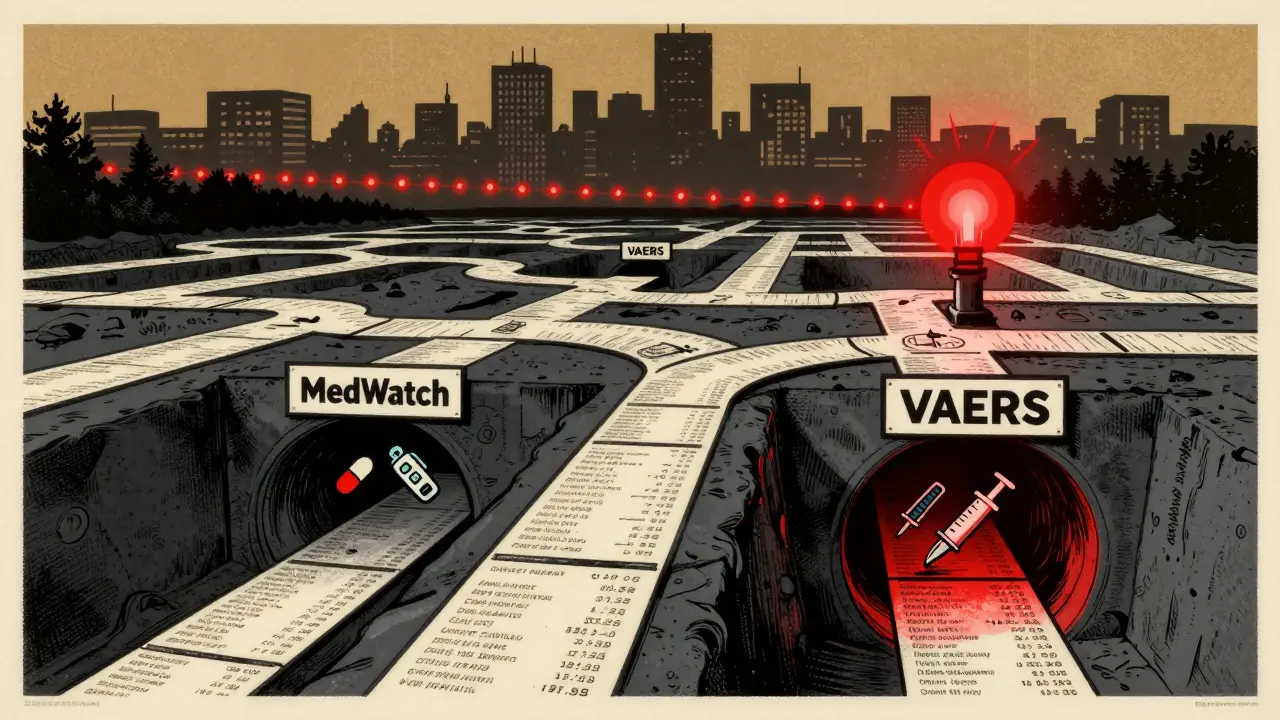
But here’s the catch: less than 1% of vaccine side effects are ever reported. Many people don’t know about VAERS. Others think it’s too much trouble. Some don’t realize their symptoms might be connected. That means VAERS is missing most of the data. It’s like trying to map a city using only streetlights you can see from a passing train.
Key Differences Between MedWatch and VAERS
Here’s the simple breakdown:
- What’s tracked: MedWatch = drugs, devices, supplements. VAERS = vaccines only.
- Who runs it: MedWatch = FDA. VAERS = CDC + FDA.
- Who reports: Both accept public reports, but manufacturers must report to MedWatch. For VAERS, manufacturers must report too, but healthcare providers are strongly encouraged to report even if they’re unsure.
- What data is collected: MedWatch focuses on product use, dosage, and medical outcome. VAERS focuses on vaccine type, lot number, timing, and symptoms.
- How it’s used: MedWatch helps FDA update labels, issue warnings, or pull products. VAERS helps CDC detect early safety signals before they become widespread.
One critical thing: never report a vaccine reaction to MedWatch. It won’t go to the right people. And never report a drug reaction to VAERS. It won’t be counted in the right system. Mixing them up delays the response.
Why Both Systems Are Flawed-And Why They Still Matter
Both MedWatch and VAERS are passive systems. That means they wait for people to report problems. They don’t go out and look for them. That’s a huge weakness. Most side effects go unreported. A 2021 study estimated that only 1% to 10% of serious drug reactions make it into MedWatch. For vaccines, the number is even lower.
Reports can be incomplete. Someone might forget to mention they were taking three other medications. A parent might not know the exact vaccine lot number. A doctor might assume the reaction was too common to report. All of that creates noise.
And then there’s bias. People who have bad reactions are more likely to report. People who feel fine don’t. That skews the data. If 100,000 people get a vaccine and 100 report side effects, that doesn’t mean 0.1% had them. It might mean 0.01% had them-and 99.99% didn’t. But without the full picture, you can’t tell.
Still, these systems save lives. They caught the link between the 1976 swine flu vaccine and Guillain-Barré syndrome. They flagged the rare blood clot risk with Johnson & Johnson’s COVID-19 vaccine within weeks. They helped identify that certain flu shots caused more fevers in young children, leading to updated dosing guidelines.
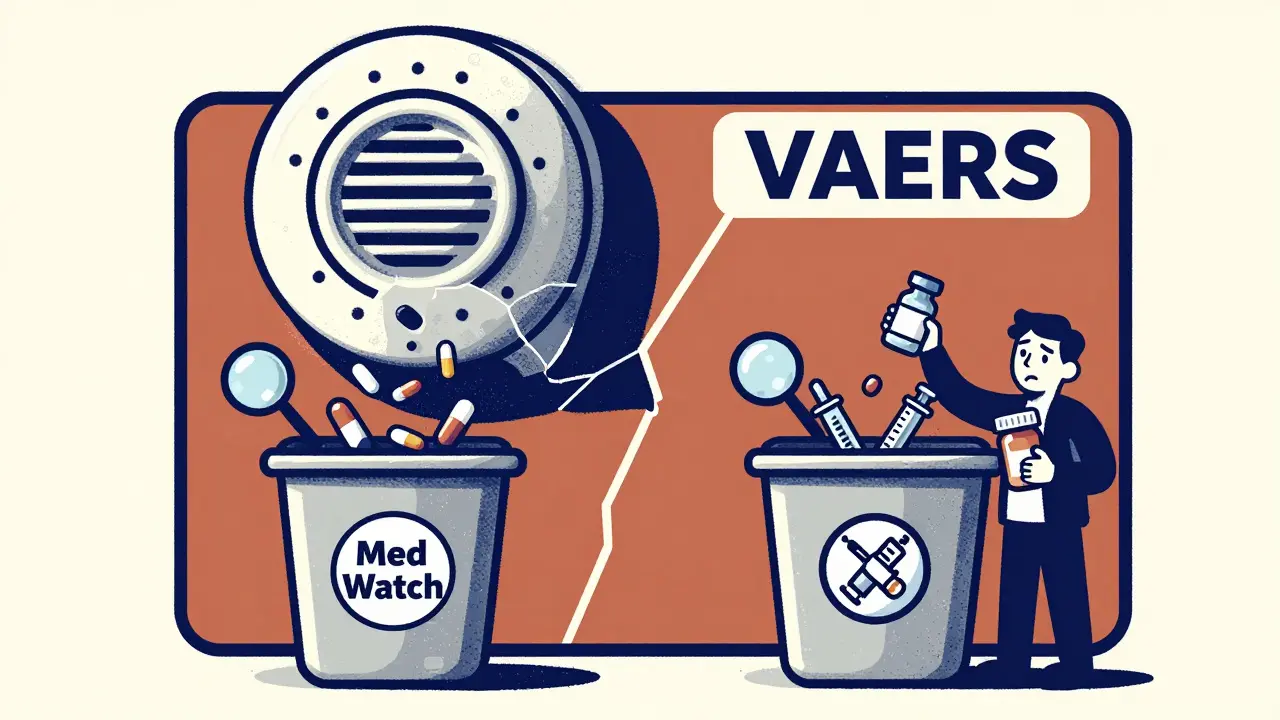
These aren’t perfect databases. They’re early warning systems. Like smoke alarms. They don’t tell you where the fire started. But they tell you there’s a fire-and that’s enough to get help.
What Happens After a Report?
After you file a report, you don’t get a call back. You won’t get a diagnosis. The system doesn’t give medical advice. That’s not its job.
What happens next depends on the system:
- In MedWatch, the FDA reviews reports in batches. If a pattern emerges across dozens of reports, the agency may issue a safety alert, update the drug label, or require a new study. In extreme cases, a drug may be pulled from the market.
- In VAERS, the CDC analyzes reports weekly. If a signal pops up-say, a spike in heart inflammation after a specific mRNA vaccine-they trigger deeper analysis using VSD or CISA. These systems use controlled data to calculate real risk levels. Only then do public health recommendations change.
Neither system tells you if your child’s fever was caused by the vaccine. But together, they help scientists figure out if a vaccine is causing more heart inflammation than expected across millions of doses.
How to Report Correctly
If you had a bad reaction, here’s how to report it right:
- Was it a vaccine? Go to vaers.hhs.gov. Fill out the form. Even if you’re unsure. Better to report and have it dismissed than to miss a signal.
- Was it a drug, device, or supplement? Go to fda.gov/medwatch. Use the online form or download the PDF.
- What to include: Date of event, product name, dose, timing after use, symptoms, your age, and any other meds you took. Don’t guess-use your records if you can.
- Don’t wait. The sooner you report, the faster a pattern might be spotted.
If you’re a healthcare provider, you’re legally required to report certain serious events. Don’t assume someone else will. Your report could be the one that prevents a larger problem.
Common Misconceptions
Let’s clear up the biggest myths:
- Myth: VAERS proves vaccines cause serious side effects. Truth: VAERS can’t prove causation. It only flags patterns for further study.
- Myth: If no one reports a side effect, it doesn’t exist. Truth: Underreporting is the norm. Just because it’s not in the system doesn’t mean it didn’t happen.
- Myth: MedWatch and VAERS are the same thing. Truth: They’re completely separate. Mixing them up breaks the system.
- Myth: Reporting a reaction means you’re saying the product is dangerous. Truth: Reporting is just saying, “This happened after I used it.” That’s all.
These systems aren’t designed to comfort people. They’re designed to protect them. And that means accepting that they’re messy, incomplete, and sometimes frustrating. But they’re also the best tools we have to catch problems before they spread.
What’s Next for Drug and Vaccine Safety?
The future isn’t just about more reports. It’s about smarter systems. The FDA is testing real-time data feeds from electronic health records and pharmacy systems. The CDC is expanding VSD to include more health plans. New AI tools are being trained to spot hidden patterns in millions of reports.
But none of that replaces the human voice. The person who notices their teen started having panic attacks after a new ADHD pill. The grandparent who remembers their daughter had a seizure after her first flu shot. Those reports matter.
So if something strange happens after you take a pill or get a shot-report it. Not because you’re sure it’s the product’s fault. But because you might be the one who helps the next person avoid it.
Can I report a side effect from a vaccine to MedWatch?
No. Vaccine side effects must be reported to VAERS, not MedWatch. MedWatch is only for drugs, medical devices, and supplements. Reporting a vaccine reaction to MedWatch means it won’t be tracked properly and could be missed by the CDC and FDA teams monitoring vaccine safety.
Are MedWatch and VAERS reliable for proving a drug or vaccine caused a reaction?
No. Neither system can prove causation. They collect reports of events that happened after using a product, but they don’t determine if the product caused them. Many reports are coincidental or incomplete. If a signal appears, agencies use more rigorous systems like the Vaccine Safety Datalink (VSD) or real-world data studies to confirm risks.
Why are so few side effects reported to VAERS and MedWatch?
Most people don’t know these systems exist. Others think their reaction was too minor, too common, or not connected to the product. Healthcare providers may assume the event is unrelated or not reportable. Underreporting is a known issue-estimates suggest less than 1% of serious adverse events are reported. That’s why these systems rely on patterns, not individual reports.
Do manufacturers have to report side effects to both systems?
Yes, but differently. Drug and device manufacturers must report serious adverse events to MedWatch by law. Vaccine manufacturers must report to VAERS. They don’t report the same events to both systems because the products are tracked separately. Mixing reports between the two would create confusion and delay detection.
If I report a side effect, will I get a response or medical advice?
No. Neither MedWatch nor VAERS provides medical advice or follows up with reporters. They are surveillance tools, not clinical services. Your report helps public health officials spot trends, but you won’t get a call back or a diagnosis. For medical concerns, always contact your healthcare provider.
Can VAERS data be used to show vaccines are unsafe?
No. VAERS data alone cannot be used to prove vaccines are unsafe. Reports include events that happened after vaccination but aren’t necessarily caused by it. For example, someone might have a heart attack weeks after a flu shot-unrelated timing. Scientists use VAERS to find signals, then test them with controlled studies. Relying only on VAERS reports leads to false conclusions.
Final Thoughts
MedWatch and VAERS aren’t flashy. They don’t make headlines. But they’re the quiet backbone of drug and vaccine safety in the U.S. They don’t prevent every bad outcome. But they catch the ones that could be widespread. And they only work if people report.
You don’t need to be a scientist. You don’t need to understand statistics. You just need to notice something unusual-and speak up. That’s how safety systems grow stronger. Not by perfect data. But by enough data, from enough people, over enough time.

Jonathan Morris
December 18, 2025 AT 04:07Let’s be clear: VAERS is a garbage fire of unverified anecdotes, and MedWatch isn’t much better. Both systems are designed to be passive, which means they’re fundamentally broken. If you’re relying on voluntary reports from people who don’t know the difference between correlation and causation, you’re not doing science-you’re doing crowd-sourced paranoia. The CDC and FDA know this. That’s why they use VSD and other controlled databases. But the public? They see a spike in reports and immediately scream ‘vaccine injury!’ No. No, no, no. This isn’t a database of proof. It’s a noise filter. And right now, the noise is drowning out the signal.
Manufacturers are legally obligated to report serious events. That’s the only part of this system that’s even remotely reliable. The rest? Pure speculation dressed up as civic duty.
And don’t get me started on people reporting flu shots to MedWatch. That’s like calling the fire department because your toaster caught fire. You’re not helping. You’re just wasting bandwidth.
Anna Giakoumakatou
December 19, 2025 AT 01:35Oh, how quaint. We’ve built a national surveillance system that operates on the same principle as a medieval plague log-handwritten notes from terrified villagers, passed along by monks who may or may not have seen the actual corpse.
MedWatch and VAERS are not ‘early warning systems.’ They are digital séances. We gather the spirits of anecdote and hope they whisper the truth. Meanwhile, the real science-the epidemiological rigor, the controlled cohorts, the longitudinal data-is happening in the shadows, far from the TikTok comment section.
And yet, we treat these passive reports like sacred scripture. How poetic. A civilization that can land rovers on Mars still believes in witch hunts… as long as they’re digitized and hosted on a .gov domain.
Sam Clark
December 19, 2025 AT 02:27Thank you for this clear, well-structured explanation. As a healthcare professional, I appreciate the emphasis on correct reporting channels. I’ve seen too many patients confused about where to report reactions, and I’ve had to redirect them multiple times. The distinction between MedWatch and VAERS is critical, and I make sure to clarify it during every patient visit involving new medications or vaccines.
It’s also important to note that while underreporting is a known limitation, the systems are intentionally designed to be low-barrier to encourage participation. We compensate for the noise through statistical analysis and follow-up studies. The goal isn’t to prove individual causation-it’s to detect population-level trends early.
Please continue to report. Even if you feel your experience is ‘ordinary,’ it contributes to a larger picture that protects future patients.
Jessica Salgado
December 19, 2025 AT 22:05I reported my son’s fever after his MMR shot-just because I didn’t know where else to put it. I didn’t think it mattered. I didn’t think anyone would care. But then I got that automated email saying ‘Your report has been received.’ And I cried. Not because I thought it was ‘proof’-but because for the first time, I felt like someone was listening.
Maybe it’s just one report. Maybe it’s noise. But what if it’s the one that, three years from now, helps a researcher spot a pattern with another vaccine? What if it’s the reason a baby in 2030 doesn’t get sick?
I’m not a scientist. I’m a mom. And I’m not going to stop reporting just because the system’s imperfect. Imperfect is better than silent.
amanda s
December 21, 2025 AT 11:39YOU’RE ALL BEING LIED TO. VAERS IS FULL OF VACCINE INJURIES AND THE GOVERNMENT IS HIDING THEM. THEY DON’T WANT YOU TO KNOW THAT THE CDC IS COVERING UP DEAD BABIES AND PARALYZED TEENS. THEY CHANGED THE LAW IN 2021 SO THEY COULDN’T BE SUED-NOW THEY DON’T CARE IF YOU DIE. REPORTING TO VAERS ISN’T ENOUGH. YOU NEED TO POST EVERY SINGLE CASE ON TIKTOK. THEY’RE KILLING US WITH MICROCHIPS AND mRNA. THE FDA IS A PHARMA PUPPET. THIS ISN’T SCIENCE-IT’S GENOCIDE.
Peter Ronai
December 22, 2025 AT 10:00Oh wow. Another ‘educational’ post from someone who thinks ‘passive surveillance’ is a fancy word for ‘reliable data.’
Let me guess-you also believe that the FDA’s ‘signal detection’ is some kind of magic crystal ball? Newsflash: VAERS data has been manipulated by CDC insiders since 2009. The ‘VSD’? A closed-loop system with cherry-picked data. And don’t even get me started on how they delete reports that don’t fit the narrative.
And you want people to report? Sure. Keep reporting. Let them bury your data in the same database where they hid the 1976 swine flu deaths. Oh wait-you think that was an accident? LOL.
This isn’t transparency. It’s theater. And you’re the audience.
Jigar shah
December 22, 2025 AT 21:35Interesting breakdown. I work in public health in India, and we don’t have anything like MedWatch or VAERS. Our adverse event reporting is mostly hospital-based and rarely reaches the national level. I’m curious-how do you ensure data quality when reports are so inconsistent? Do you have any automated tools to flag duplicate entries or implausible timelines (e.g., a reaction reported 18 months after vaccination)?
Also, is there any effort to integrate VAERS data with pharmacy dispensing records? That could help correlate timing more accurately.
Kent Peterson
December 24, 2025 AT 00:04STOP. JUST… STOP.
MedWatch? VAERS? Please. You think this is how a real country tracks drug safety? We have a system that relies on people typing ‘I felt weird after my pill’ into a government form? That’s not science. That’s a joke. A 10-year-old could do better with a Google Form and a napkin.
Real countries use electronic health records, AI-driven analytics, and mandatory reporting from every pharmacy, clinic, and ER. We don’t wait for people to remember their symptoms two weeks later and type ‘I think it was the blood pressure med’ into a 1998-style website.
And you call this ‘the best we have’? That’s not confidence. That’s surrender.
Also-why does VAERS ask for lot numbers? Because they’re tracking microchips, obviously. Duh.
Josh Potter
December 25, 2025 AT 16:16bro i just took a new anxiety med and my hand started tingling and i thought ‘is this normal??’ so i went to medwatch and filled it out in 3 mins. i didn’t even know this was a thing. i thought it was just for doctors. now i feel like a superhero. like i just saved 1000 people from the same thing.
also i reported my cousin’s weird rash after the shingles shot-she thought it was just poison ivy. turns out it was probably the vaccine. so yeah. report stuff. even if you’re not sure. it’s free. and it might save someone’s life. or at least make someone else feel less alone.
Evelyn Vélez Mejía
December 26, 2025 AT 20:12These systems are not merely administrative tools-they are moral artifacts. They represent a societal contract: that we will listen, however imperfectly, to those who suffer. That we will not dismiss the anecdote as noise, but as the first tremor of a deeper earthquake.
MedWatch and VAERS are the last bastions of epistemic humility in an age of algorithmic certainty. They do not pretend to know. They do not claim to prove. They simply record. And in that recording, they affirm the dignity of the individual experience-even when it contradicts the statistical norm.
To dismiss them as ‘flawed’ is to misunderstand their purpose. They are not instruments of proof. They are instruments of witness. And witness, in the face of institutional indifference, is the most radical act we have left.
Jane Wei
December 27, 2025 AT 20:38i just reported my dog’s seizure after his heartworm pill. yeah, i know it’s not a human. but i figured if it’s a ‘medical product’ then maybe someone should know. no one ever said ‘only humans.’
Nishant Desae
December 28, 2025 AT 18:57Wow, this is such an important post. I’ve been working with rural communities in India, and most people have no idea these systems even exist. Many think if something bad happens after a vaccine, it’s just ‘bad luck’ or ‘God’s will.’ I’ve been trying to spread awareness-using WhatsApp groups, local radio, even posters in temples and clinics. But it’s slow. People are scared to report because they think they’ll be blamed or that nothing will change.
But I keep telling them: your voice matters. Even if you’re not a doctor. Even if you’re not sure. If your child got sick after the shot, and you report it, maybe next time a doctor will think twice before giving the same vaccine to another child with the same condition.
And honestly? I think the fact that anyone can report is beautiful. It means we trust ordinary people to be part of the solution. Not just the experts. Not just the corporations. Us. All of us.
Jody Patrick
December 29, 2025 AT 16:07Report to VAERS for vaccines. MedWatch for pills. Don’t be stupid.