
Every year, millions of people in the U.S. take prescription meds without ever checking if they’re real. That’s a problem because counterfeit drugs are more common than you think. The FDA doesn’t just regulate medicine - it runs a set of public databases that let anyone with the right knowledge verify whether a drug is legitimate. You don’t need to be a pharmacist to use them. But you do need to know where to look and what to look for.
What the FDA Actually Tracks
The U.S. Food and Drug Administration doesn’t just approve drugs - it tracks every single one that enters the market. The core of this system is the National Drug Code (NDC) Directory a public database maintained by the FDA that contains unique identifiers for all prescription and over-the-counter drugs sold in the United States. Every drug has a 10- or 11-digit NDC number split into three parts: the labeler code (who made it), the product code (what it is), and the package code (how it’s packaged). This isn’t just a number - it’s a fingerprint. If the NDC on your pill bottle doesn’t match what’s in the FDA’s database, something’s wrong.
The NDC Directory is updated every single business day. That means if a drug gets pulled from the market, removed from sale, or newly approved, the change shows up within 24 hours. It’s one of the most reliable sources for verifying drug authenticity. You can search it directly on the FDA website using the drug name, NDC number, or even the manufacturer’s name.
Who’s Allowed to Make Drugs?
Not every company that says it makes medicine actually can. The Drug Establishments Current Registration Site a live list of all FDA-registered drug manufacturing, repackaging, and distribution facilities in the U.S. tells you exactly which facilities are legally authorized to handle pharmaceuticals. Every facility must renew its registration between October 1 and December 31 each year. If a company’s registration expired last year and they didn’t renew, they’re not allowed to operate - and any drugs they’re selling are technically illegal.
Want to check if your pharmacy’s supplier is legit? Just search the facility name or address. If it doesn’t show up here, that’s a red flag. The FDA removes inactive facilities automatically, so this list is always current. This isn’t just for big manufacturers - even small compounding pharmacies and overseas suppliers who export to the U.S. must be listed here.
How Counterfeit Drugs Slip Through
Counterfeit drugs don’t always look fake. Sometimes they’re perfectly packaged, labeled, and even contain real active ingredients. But they’re still dangerous. They might be expired, contaminated, or stored improperly. Others contain no medicine at all - just sugar, chalk, or worse. The FDA’s databases help catch these by tracking the entire supply chain.
Here’s how the system works: Every time a drug changes hands - from manufacturer to wholesaler to pharmacy - electronic records must be exchanged. Since November 2023, the Drug Supply Chain Security Act (DSCSA) a federal law requiring full electronic tracing of prescription drugs through every step of the supply chain requires every trading partner to verify each package before passing it along. If a drug’s identifier doesn’t match what the manufacturer recorded, it gets quarantined.
But here’s the catch: the system only works if everyone plays by the rules. In 2022, nearly 40% of verification failures happened because two companies used different formats for the same NDC number. A small mistake like that can let a fake drug slip through unnoticed.
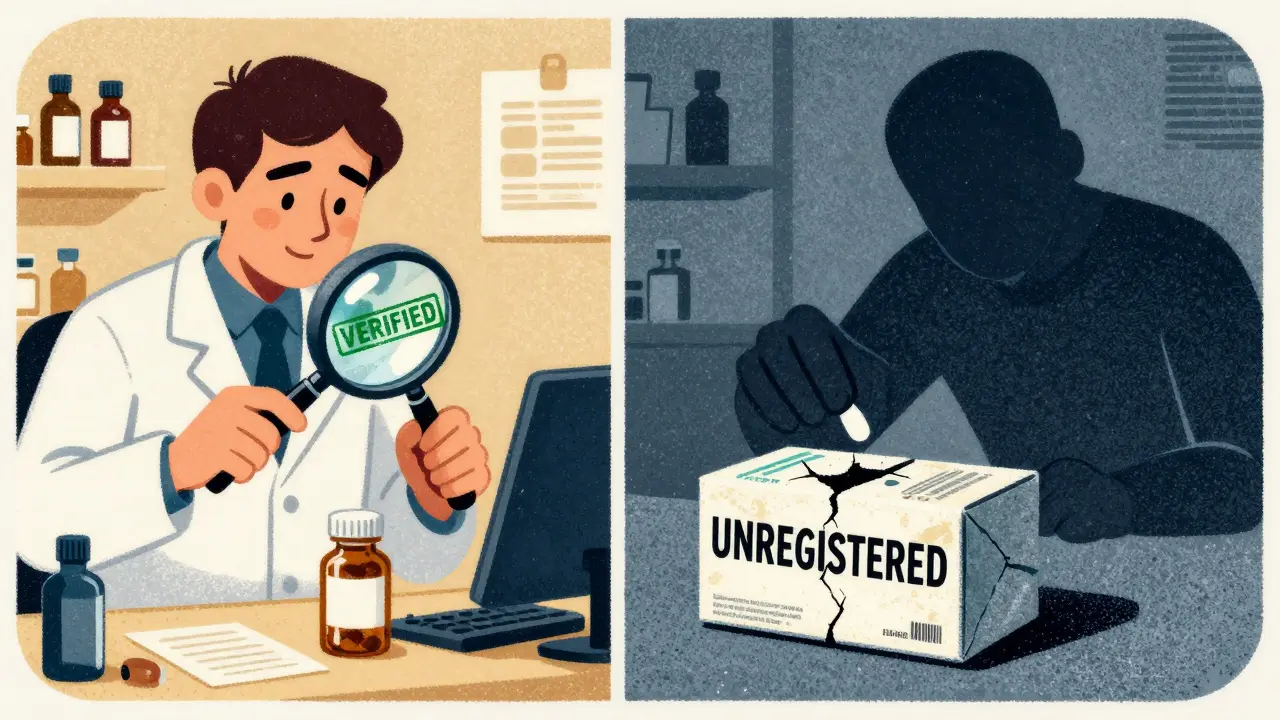
Spotting Fake Drugs Yourself
You can’t access the full DSCSA system - it’s for industry use only. But you can still protect yourself. Here’s how:
- Check the NDC number on your prescription bottle. Look it up in the FDA’s NDC Directory. If it’s not there, or the details don’t match (like dosage or packaging), call your pharmacist.
- Compare packaging. Legit drugs have consistent fonts, colors, and batch numbers. If your pills look different from last time - even slightly - ask why.
- Verify your pharmacy. Use the Drug Establishments Current Registration Site to check if your pharmacy’s supplier is registered. If you buy online, make sure the site is verified by the National Association of Boards of Pharmacy (NABP).
- Watch for price drops. If a drug suddenly costs half what it did last month, it’s a warning sign. Counterfeiters undercut prices to lure buyers.
Real-world example: In 2021, a patient in Ohio noticed his blood pressure pills looked different. The NDC number matched the FDA database, but the pill imprint was off. He reported it. The FDA traced it back to a repackager in Texas that had failed to update its listing. The batch was pulled. That’s how the system catches fraud - when someone pays attention.
What’s Changing in 2026
The FDA is upgrading its system. Starting in 2026, all NDC numbers will switch from 10- or 11-digit formats to a standardized 12-digit version. This will reduce errors, make digital scanning easier, and improve tracking accuracy. The agency is also adding product images to the NDC Directory by late 2024. That means you’ll soon be able to see what the real packaging looks like - right in the database.
Meanwhile, AI tools are starting to help. Companies like IBM and Google are testing machine learning models that scan supply chain data for anomalies. These systems can detect patterns humans miss - like a drug being shipped from a warehouse in Mexico to a pharmacy in Minnesota without proper documentation. Early tests show these tools catch 99% of fake drugs, compared to 87% with current methods.
What You Can’t Fix
Not every drug is covered. The FDA’s system applies mostly to prescription medications. Compounded drugs, dietary supplements, and imported drugs from countries without DSCSA compliance are still vulnerable. About 35% of foreign manufacturers don’t meet U.S. standards. That’s why counterfeit drugs still show up - especially online.
Also, small pharmacies and independent clinics often lack the budget to implement full DSCSA systems. The average cost to install compliant software is nearly $300,000. That’s why some rural pharmacies still rely on paper records. It’s a gap counterfeiters know about.
Why This Matters
Counterfeit drugs aren’t just a business problem - they’re a public health crisis. The FDA estimates that fake medicines cause over 100,000 deaths globally each year. In the U.S., incidents have risen 18% annually since 2018. The tools to stop them exist. The databases are free. The knowledge is public.
If you take medication regularly - whether for diabetes, heart disease, or mental health - you have the right to know it’s real. The FDA didn’t build these systems for lawyers or regulators. They built them for you. All you need to do is look.
How do I find the NDC number on my medicine?
The NDC number is printed on the drug packaging - usually on the side or bottom of the bottle, box, or blister pack. It’s a 10- or 11-digit number, often formatted like 12345-678-90. If you can’t find it, check the label or ask your pharmacist. Some online pharmacies list it in the product details.
Can I use the FDA databases if I’m not in the U.S.?
Yes. The FDA’s NDC Directory and Drug Establishments site are publicly accessible from anywhere. But if you’re outside the U.S., the drugs listed may not be available in your country. The databases track drugs sold in the U.S. market, so they won’t help verify medications sold only in other regions.
What if my drug isn’t in the NDC Directory?
If a drug doesn’t appear in the FDA’s database, it may be unapproved, expired, or counterfeit. Some compounded drugs, veterinary medications, or imported products aren’t required to be listed. But if it’s a standard prescription drug - like metformin or lisinopril - and it’s missing, that’s a major red flag. Contact your pharmacist or report it to the FDA.
Do generic drugs have different NDC numbers than brand-name ones?
Yes. Even if two drugs have the same active ingredient, each manufacturer uses its own NDC number. A generic version of Lipitor, for example, will have a completely different NDC than the brand-name version. That’s normal. What matters is that both numbers appear in the FDA’s database and match the product description.
How often does the FDA update its databases?
The NDC Directory is updated daily. The Drug Establishments Current Registration Site updates every business day. Any new registration, change, or removal is reflected within 24 hours. This real-time update is why these databases are so reliable for verifying drug legitimacy.
What to Do Next
If you’re worried about a medication you’re taking, don’t guess. Go to the FDA’s website. Search the NDC Directory. Check the manufacturer’s registration. Compare the pill’s appearance to official images (when available). If something feels off, call your pharmacy. Ask them to verify the supplier. Most will be happy to help.
Counterfeit drugs thrive on silence. The more people who check, the harder it is for fakes to survive. You don’t need to be an expert. You just need to be curious - and willing to look.
Gabrielle Conroy
February 22, 2026 AT 11:59OMG, I had NO idea the FDA had all this public info!! 🙌 I just checked my blood pressure med’s NDC number and it matched perfectly-thank you for this!! I always just trusted the pharmacy, but now I’m gonna check every time. This feels like a superpower!! 💊🔍 Also, the 2026 12-digit shift? So smart. I’m telling all my friends with chronic meds to do this. We’re literally saving lives by being lazy and googling. 😘
Spenser Bickett
February 24, 2026 AT 01:01so like… the fda has a database… and we’re supposed to *care*? wow. groundbreaking. next you’ll tell me water is wet and the sky is blue. i mean, sure, it’s cool that you can check if your pill isn’t just sugar cubes from a guy in a garage in guangzhou… but do you really think the average person gives a single damn? nah. they’ll keep buying from amazon because it’s $3 cheaper and they’re too busy scrolling tiktok to read a 10-digit number. this post is basically a lecture for people who already do it right. 🤡
Christopher Wiedenhaupt
February 24, 2026 AT 03:25While the tone of this post is appropriately urgent, I’d like to add a minor clarification: the NDC Directory does not include veterinary medications or compounded drugs, as noted. However, many state pharmacy boards maintain their own searchable databases for compounded formulations. Additionally, the Drug Establishments site can be filtered by state-useful if you’re verifying a local compounding pharmacy. I’ve personally used this to confirm a specialty pharmacy in my area before filling a rare autoimmune med. Small steps matter. Also, the DSCSA rollout has been patchy-some wholesalers still use Excel sheets. Don’t assume automation = perfection.
John Smith
February 25, 2026 AT 05:33Wow. A government database. How novel. Next you’ll tell us to wash our hands and eat vegetables. I’m sure the FDA’s 24-hour updates are doing wonders against the $12 billion counterfeit market. Meanwhile, my cousin in Arizona got his diabetes meds from a “pharmacy” that turned out to be a Walmart parking lot kiosk. He’s fine. The system works. Just ask the 100k dead. 😌
Shalini Gautam
February 26, 2026 AT 12:35As someone from India, I can say this is super relevant! We have a huge problem with fake drugs here too-sometimes even real brands are counterfeited. But the fact that the FDA makes this public? That’s actually inspiring. I’m going to share this with my family back home. We need more transparency like this globally. Maybe the WHO should take notes. And yes, I just checked my mom’s blood sugar meds-NDC matched! 🙏💪
Natanya Green
February 27, 2026 AT 11:16OH MY GOSH, I JUST DID THIS!! I was paranoid about my new antidepressant because the pills looked slightly different-so I looked up the NDC number and IT WAS A MATCH!! I almost cried. Like, I didn’t even know this was a thing!! I’m so glad I didn’t ignore my gut feeling. This is why we need more people to speak up. If you’re scared, check it. If you’re confused, check it. If you’re just vibing? CHECK IT ANYWAY. YOU’RE WORTH IT. 💕💊
Steven Pam
March 1, 2026 AT 00:05This is one of those posts that makes you feel like the world’s not completely broken. Seriously. I work in healthcare IT and I’ve seen how messy the supply chain is-paper records, mismatched formats, outdated systems. But knowing that the FDA is pushing for images and standardization? That’s huge. And the AI tools? They’re not sci-fi anymore. I’ve seen demos where the system flags a shipment because the shipping route doesn’t make sense. It’s like a drug version of Uber’s fraud detection. We’re getting better. Not perfect. But better. Keep checking. Keep asking. We’re building a safer system, one pill at a time.
Dominic Punch
March 2, 2026 AT 17:02Just wanted to say-this isn’t just about checking NDCs. It’s about asking your pharmacist: ‘Who supplies this?’ and ‘Is this batch registered?’ Most won’t know. But if enough people ask, they’ll start learning. I’ve been doing this for years. Once, I caught a batch of generic metformin that had a different color coating. Turned out the repackager hadn’t updated their FDA listing. They pulled it. I didn’t get a medal. But I got peace of mind. That’s the win.
Khaya Street
March 3, 2026 AT 13:27Interesting. But let’s be real: if you’re paying $4 for a 30-day supply of insulin at a gas station pharmacy, you’re not checking NDC codes. You’re checking if the guy behind the counter has a pulse. The system works for the middle class. The rest of us? We’re just hoping. This post is well-researched. But it ignores the real problem: access. You can’t verify what you can’t afford.