
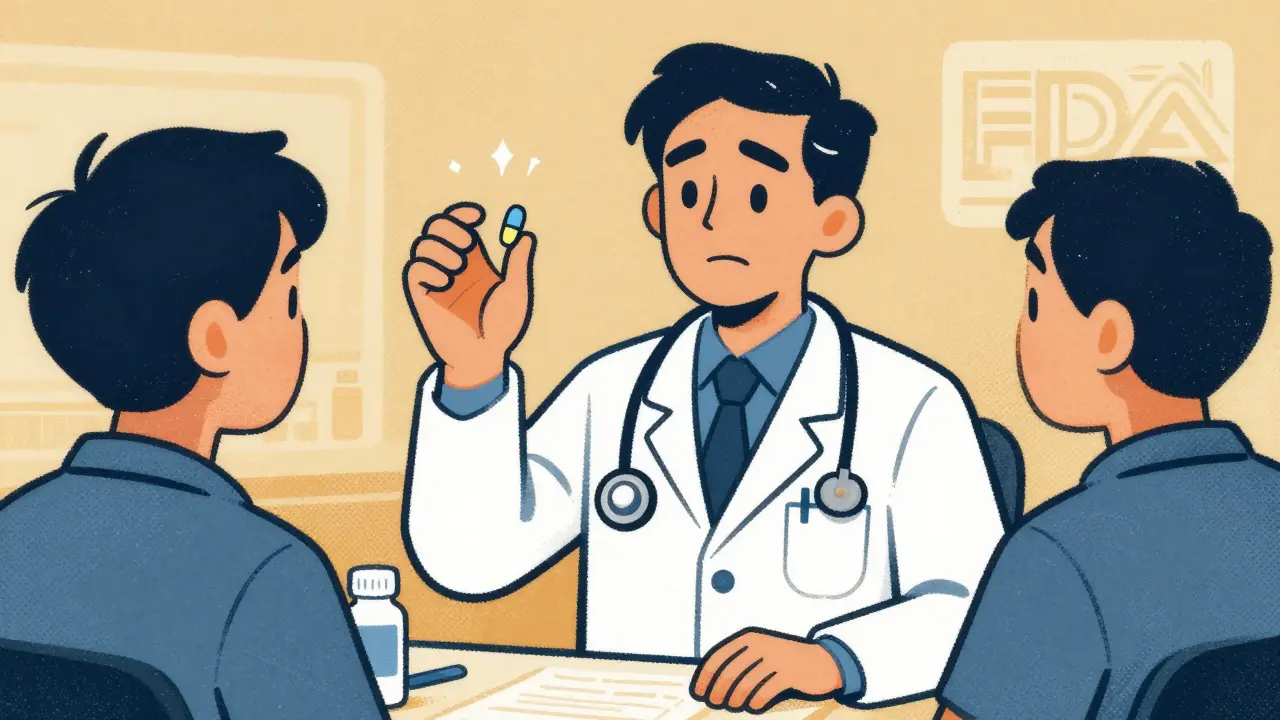
When your doctor hands you a prescription for a generic drug, do you wonder if it’s really the same as the brand-name version? Many patients do-and that’s not because the science says otherwise. It’s because clinician communication-or the lack of it-shapes what patients believe. In fact, research shows that how a healthcare provider talks about generics has more impact on whether a patient takes the medication than the drug’s price, its FDA approval status, or even personal cost savings.
Let’s be clear: generic drugs are not cheaper because they’re weaker. They’re cheaper because they don’t carry the marketing costs of brand-name drugs. The FDA requires generics to have the same active ingredients, strength, dosage form, and route of administration as the brand. Most importantly, they must deliver the same amount of drug into the bloodstream within a tight range: 80% to 125% of the brand’s effect. That’s not a guess. That’s science. And yet, nearly 30% of patients still believe brand-name drugs work better. Why? Because too often, no one explains it to them.
Communication Is the Deciding Factor
A 2011 study of nearly 2,000 patients found that the single biggest predictor of whether someone would accept a generic medication wasn’t income, education, or even how much they knew about drugs. It was whether their doctor or pharmacist had taken the time to talk about it. Patients who received clear, confident communication were 37% more likely to stick with the generic. That’s not a small difference. That’s a game-changer.
Compare that to another finding: over half of patients said their doctors or pharmacists never or seldom discussed generic options. When you hand someone a pill with a different color or shape and say nothing, it’s no surprise they start to worry. Their brain fills the silence with doubt. Is this the real thing? Did they cut corners? Will it even work?
One patient on Reddit shared how a cardiologist changed their mind: “He spent 10 minutes showing me the FDA data, explained that the generic amlodipine is identical to Norvasc, and told me he takes generics himself. I’ve been on it for two years-no issues.” That kind of conversation doesn’t just inform. It builds trust.
What Makes Communication Work?
Not all explanations are created equal. Saying “This is a generic, it’s cheaper” isn’t enough. The most effective communication includes three key pieces:
- Authority: Mentioning the FDA’s 80-125% bioequivalence standard isn’t jargon-it’s proof. Patients need to know this isn’t a loophole. It’s a strict, science-backed requirement.
- Confidence: Avoid phrases like “Let’s try this and see how it goes.” That sounds like an experiment, not a treatment. Instead, say: “This generic is just as safe and effective as the brand. I’ve prescribed it to hundreds of patients with the same results.”
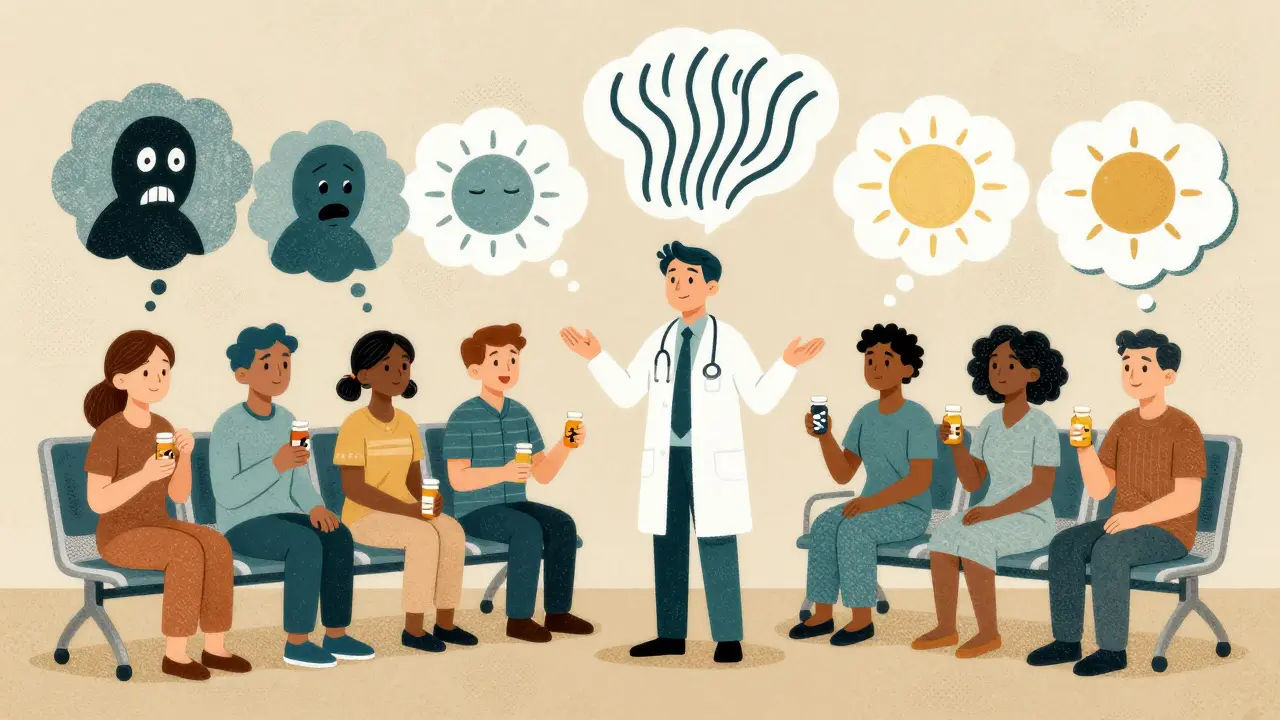
- Nocebo awareness: Some patients report side effects after switching to generics-even when the drug is identical. This isn’t a drug issue. It’s an expectation issue. When clinicians explain that the mind can create symptoms from fear, patients are 28% less likely to report problems.
A 2019 JAMA study showed that patients who heard this kind of explanation didn’t just feel better-they actually had fewer symptoms. The placebo effect has a dark twin: the nocebo effect. When you expect harm, your body can respond as if it’s real. Good communication stops that before it starts.
Who’s Most at Risk?
Communication gaps don’t affect everyone equally. A 2016 NIH survey found that non-Caucasian patients were 1.7 times more likely to distrust generics. Patients earning under $30,000 a year were 2.3 times more likely to insist on brand-name drugs. That’s not about ignorance. It’s about history. For many, brand names are tied to quality, reliability, and trust-often because of decades of targeted advertising.
One study found that culturally competent communication-tailoring language, examples, and tone to a patient’s background-reduced skepticism by 41% among non-Caucasian patients. That means using analogies they relate to, acknowledging their concerns without dismissing them, and sometimes even sharing personal stories. “I take generics too” is powerful because it humanizes the provider.
The Cost of Silence
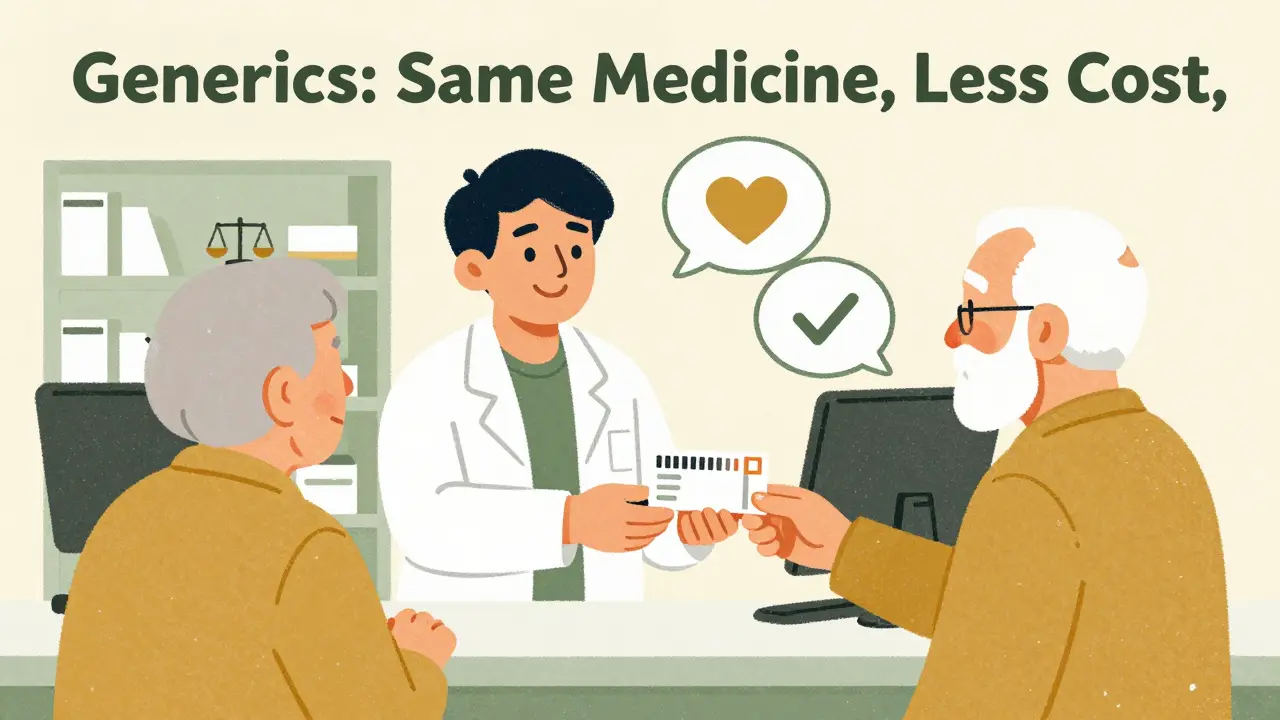
The economic impact of generics is massive. In the U.S., 90% of prescriptions filled are for generics, but they account for only 23% of total drug spending. That’s $37 billion saved every year. Yet, brand-name preference requests have climbed from 12% in 2010 to 23% in 2022. Why? Because price alone doesn’t change belief.
One Healthgrades review captured the problem: “My pharmacist just handed me a different pill. When I complained of headaches, he said, ‘Some people react to generics.’ I stopped taking it for three weeks.” That’s not just bad communication-it’s clinical negligence. The patient didn’t just lose a dose. They lost trust in the system.
Analysis of over 4,200 patient reviews found that 78% of positive experiences mentioned clinician communication. Meanwhile, 89% of negative ones blamed poor or absent explanations. The difference isn’t the drug. It’s the conversation.
What’s Being Done?
Some systems are catching on. Kaiser Permanente rolled out a “Generic First” program with mandatory training and standardized scripts. Result? 94% of prescriptions filled were generic. They saved $1.2 billion in one year.
The FDA now provides free, plain-language patient materials in 12 languages. Epic Systems, the EHR giant, added a “Generic Confidence Score” to its electronic records. It prompts doctors with questions like: “Did you explain bioequivalence?” or “Did you address patient concerns?”
And in 2024, the American Medical Association started including generic communication effectiveness in physician evaluations. For the first time, how well you explain a generic is part of your professional performance.
What You Can Do
If you’re a patient: Ask. Say, “Can you tell me why this generic is safe?” or “Is this really the same as the brand?” Most providers welcome the question. It shows you’re engaged.
If you’re a provider: Don’t assume. Even if you think it’s obvious, it’s not. Use the four-point framework: (1) Explain FDA standards, (2) Confirm identical active ingredients, (3) Highlight cost savings (80-85% less), and (4) Proactively address nocebo effects. Keep it simple. Keep it honest.
If you’re a pharmacist: You’re often the last person to talk to the patient before they leave the pharmacy. Use those 30 seconds. Say: “This is the same medicine, just without the brand name. It’s been approved by the FDA and works just as well. I’ve used it myself.”
The Future
By 2025, Medicare Part D will tie reimbursement to how well providers communicate about generics. The CDC plans to make it part of national health literacy standards. As more complex generics-like inhalers and injectables-enter the market, communication will become even more critical.
The science is settled. Generics work. But belief isn’t built on data sheets. It’s built on trust. And trust is built one conversation at a time.
Jonathan Noe
February 14, 2026 AT 21:45Brad Ralph
February 15, 2026 AT 00:20Meanwhile, Big Pharma is still out here making ads where a glowing heart floats out of a branded pill like it's a Pixar short. We're fighting misinformation with... silence? The system is a sitcom.
Kristin Jarecki
February 15, 2026 AT 15:46Suzette Smith
February 17, 2026 AT 12:19christian jon
February 19, 2026 AT 05:48YOU LET THE GOVERNMENT APPROVE A PILLS THAT LOOKS LIKE A CHALK DRAWING AND THEN YOU WON'T EVEN TELL PEOPLE IT'S THE SAME?!
THEY'RE GIVING US PLACEBO PILLS IN DISGUISE AND CALLING IT 'SCIENCE'?!
I SAW A VIDEO WHERE A MAN TALKED TO HIS DOCTOR ABOUT GENERIC LISINOPRIL AND THEN HIS CAT STARTED MEOWING IN A DIFFERENT KEY. THIS IS A COVER-UP. THE FDA IS A FRONT FOR BIG PHARMA AND THE CABLE NEWS NETWORKS ARE IN ON IT. I HAVE DOCUMENTATION. I WILL FILE A CLASS ACTION. I AM NOT KIDDING.
Autumn Frankart
February 21, 2026 AT 02:16Pat Mun
February 23, 2026 AT 00:08That moment changed everything. Not because of the science - though it’s solid - but because he made me feel like I wasn’t being sold something second-rate. He made me feel respected. That’s what matters. Not the pill. The person behind it.
And if you’re a provider reading this - please, don’t assume we know. We don’t. We’re scared. Talk to us like we’re human. Not a statistic.
andres az
February 24, 2026 AT 20:30Carla McKinney
February 25, 2026 AT 00:36Ojus Save
February 25, 2026 AT 17:18Jack Havard
February 25, 2026 AT 23:33Jason Pascoe
February 27, 2026 AT 18:47