
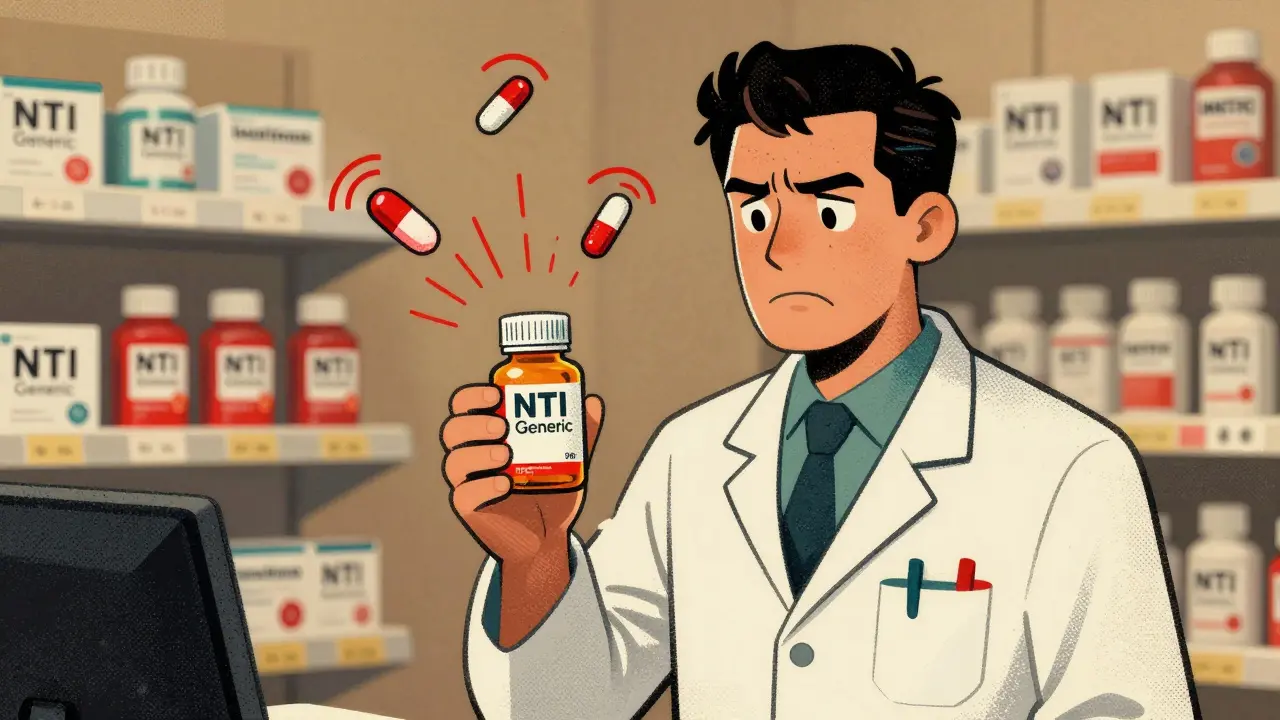
When a pharmacist hands you a pill bottle labeled as a generic version of your brand-name medication, most of the time, it’s safe and effective. But for drugs with a narrow therapeutic index (NTI), that simple swap can carry serious risks. These aren’t just any medications-they’re the kind where even a tiny difference in how your body absorbs the drug can mean the difference between treatment success and life-threatening complications. And pharmacists, the frontline professionals who dispense these drugs, are sounding the alarm.
What Makes a Drug an NTI Drug?
NTI drugs have a very small window between the dose that works and the dose that causes harm. A few milligrams too much or too little can lead to toxicity or therapeutic failure. Think of it like walking a tightrope-step just a bit off balance, and you fall. Common examples include warfarin (a blood thinner), levothyroxine (for thyroid function), phenytoin (for seizures), and carbamazepine (for epilepsy and nerve pain).
The FDA doesn’t publish an official list of NTI drugs, but it does flag them in the Orange Book with therapeutic equivalence codes. Drugs marked with a ‘B’ code are flagged as potentially problematic for substitution. Even among generics, only about 6% are NTI drugs-but they’re responsible for over 20% of pharmacist substitution concerns. Why? Because the rules that work for most generics don’t always work here.
Why Pharmacists Are Worried
Standard generic drugs must prove they’re 80-125% as bioavailable as the brand-name version. That’s a wide range. For NTI drugs, the FDA recommends a much tighter window: 90-111%. But even that’s not always enforced consistently. In 2024, the University of Minnesota found 42 drugs with recommended narrower ranges, and 15 of them had documented clinical consequences when substitutions went outside those limits.
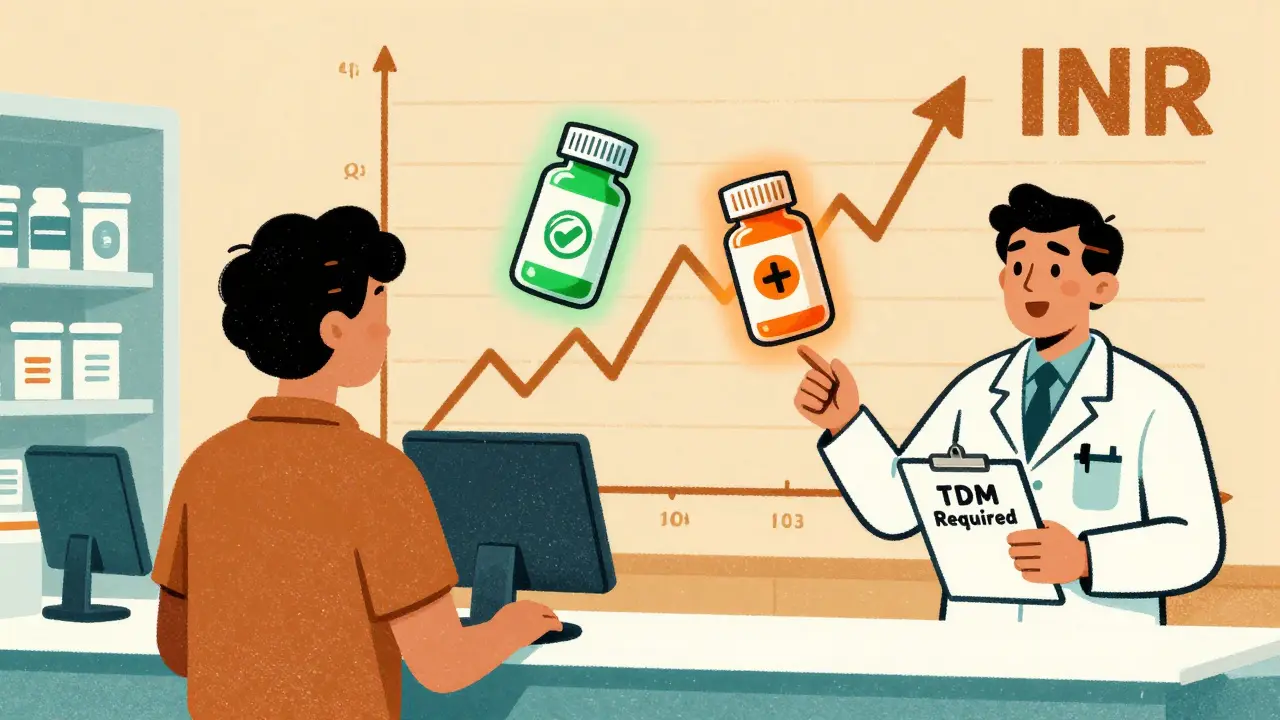
Pharmacists see the fallout. One hospital pharmacist in Ohio reported three cases in six months where switching a patient from one generic warfarin to another caused dangerous INR spikes-leading to hospitalizations. On Reddit’s r/pharmacy, a top thread with nearly 300 upvotes detailed how phenytoin levels went haywire after a generic switch, forcing emergency lab tests and dose adjustments.
According to the American Society of Health-System Pharmacists (ASHP), 68% of pharmacists surveyed in 2024 expressed concern about NTI generic substitutions. That’s not just caution-it’s experience. Many have seen patients stabilize on one brand of generic, only to have their condition unravel after switching to a different manufacturer’s version. Even if both are technically “bioequivalent,” real-world variability in fillers, coatings, and dissolution rates can make a measurable difference.
The Cost-Savings Trap
Generics save money-no question. NTI generics cost 80-85% less than their brand-name counterparts. That’s huge for patients, especially those on long-term therapy. One independent pharmacy owner told me they saw a 35% drop in patients abandoning prescriptions when generics became available. That’s a win.
But here’s the catch: when you switch between different generic manufacturers, you’re not just changing the label-you’re changing the drug’s behavior in the body. The FDA’s Adverse Event Reporting System recorded 1,247 adverse events linked to NTI generic substitutions between 2020 and 2024. For non-NTI generics? Just 382. That’s more than triple the risk.
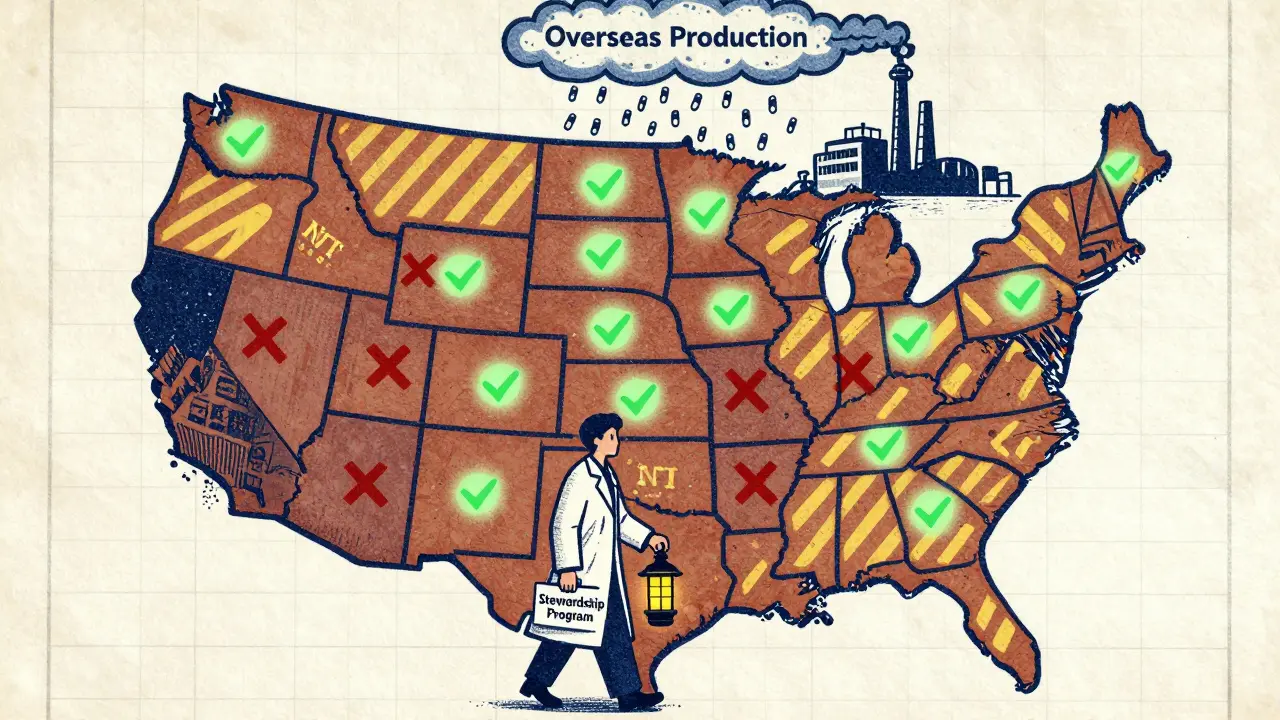
And it’s not just about individual pills. Drug shortages hit NTI drugs harder. In Q1 2025, 17% of all active drug shortages were NTI drugs-even though they make up only 6% of generic prescriptions. Why? Because production is concentrated in a few foreign facilities. Eighty percent of generics are finished overseas, and for NTI drugs, that number is even higher. One supply chain hiccup can leave entire clinics without a reliable source of warfarin or levothyroxine.
State Laws and the Patchwork Problem
Here’s where things get messy. In the U.S., pharmacists can automatically substitute generics unless the prescriber says “do not substitute.” But for NTI drugs, that rule doesn’t always make sense.
As of January 2025, only 28 states have laws restricting automatic substitution for NTI drugs. Twenty-two states require the prescriber to notify the pharmacist before substitution. Six states ban it outright. That means a patient in California might get a warning before their levothyroxine is switched, but the same patient in Texas could be handed a different generic with no notice at all.
And it’s not just about laws-it’s about communication. The National Community Pharmacists Association found that 73% of community pharmacists get calls from doctors asking them to avoid switching NTI generics. Yet, without a clear system to track which version the patient is on, pharmacists are left guessing. One pharmacist in Florida described it as “playing Russian roulette with thyroid levels.”
What Pharmacists Are Doing About It
Forward-thinking pharmacies are building protocols. The University of California, San Francisco recommends a 48-hour learning curve for staff: review the patient’s history, check therapeutic drug monitoring (TDM) results, and document every substitution. Hospitals that use a single-source policy-keeping the same generic manufacturer for each NTI drug-report 63% fewer fluctuations in patient levels.
Pharmacy residency programs are catching up, too. Eighty-one percent now include specialized NTI drug training, something that was rare just five years ago. Pharmacists are learning how to interpret INR trends, TSH levels, and serum phenytoin concentrations-not just fill prescriptions.
Resources like the FDA’s Therapeutic Equivalence Ratings database and the Association for Accessible Medicines’ NTI Drug Information Portal are being used more than ever. In 2024, the portal had over 127,000 unique visitors. That’s not just curiosity-it’s professionals trying to get it right.
The Bigger Picture: Supply Chains and Policy
The FTC’s 2025 investigation into drug middlemen pointed to group purchasing organizations (GPOs) as a key driver of NTI drug instability. GPOs push for the cheapest generic, often without considering clinical impact. A pharmacy might get a 15% discount by switching to a new supplier, but if that switch causes three patients to have seizures or clots, the cost isn’t just financial-it’s human.
The Medicare Drug Price Negotiation Program, rolling out in 2026, includes three NTI drugs among its first 10 targets. That’s a step toward lowering costs. But Lisa Schwartz of the NCPA warned that the 21-day reimbursement delay could force community pharmacies to stop stocking these drugs altogether. If a pharmacy can’t afford to hold inventory for weeks without payment, they’ll stop carrying them. And who suffers? The patients.
What’s Next?
The FDA announced in April 2025 that it’s developing a new bioequivalence framework for critical dose drugs, with stricter standards for 12 high-priority NTI drugs expected by 2026. Pharmacists are cautiously optimistic. But many still believe the current system isn’t enough.
Seventy-four percent of healthcare systems plan to launch pharmacist-led NTI drug stewardship programs by 2027. That means pharmacists won’t just be dispensers-they’ll be active participants in prescribing decisions, monitoring labs, and coordinating with prescribers. It’s a shift from passive to proactive care.
For now, the message from pharmacists is clear: NTI generics aren’t inherently bad. They’re essential for access and affordability. But they demand more care, more communication, and more consistency than standard generics. The system needs to catch up to the science-and the patients deserve nothing less.
Are all generic drugs the same as brand-name drugs?
For most medications, yes-generic drugs meet FDA standards for safety and effectiveness. But for narrow therapeutic index (NTI) drugs like warfarin, levothyroxine, or phenytoin, even small differences in absorption can lead to serious side effects or treatment failure. That’s why pharmacists are cautious about switching between different generic versions of these drugs.
Why is warfarin so tricky with generics?
Warfarin has a very narrow range between an effective dose and a dangerous one. A small change in how much of the drug enters your bloodstream can cause your INR to spike or drop, leading to clots or bleeding. Different generic versions, even if labeled as bioequivalent, can vary slightly in how they dissolve or are absorbed. That’s why many pharmacists and doctors prefer to keep patients on the same generic manufacturer long-term.
Can I ask my pharmacist to stick with one generic brand?
Absolutely. You have the right to request the same generic version each time. Tell your pharmacist you want to stay on the same manufacturer to avoid fluctuations. Many will honor this request, especially for NTI drugs. If they can’t, ask them to check with your prescriber about writing "dispense as written" on the prescription.
What should I do if I feel different after switching to a new generic?
Don’t ignore it. If you notice new symptoms-like unusual fatigue, dizziness, irregular heartbeat, or changes in mood-contact your doctor and pharmacist right away. For NTI drugs like levothyroxine or phenytoin, blood tests can quickly show if your levels have shifted. Keep a log of when you switched and what you noticed. That information helps your care team act fast.
Are there laws protecting me from automatic NTI generic switches?
It depends on where you live. As of 2025, 28 states have laws limiting automatic substitution for NTI drugs, and 22 require prescriber notification. Six states ban automatic substitution entirely. Check your state’s pharmacy board website or ask your pharmacist what rules apply in your area. If your state doesn’t have protections, you can still request to stay on the same generic-pharmacists can often accommodate that.


Matt Davies
December 17, 2025 AT 18:23Man, I never realized how wild this stuff is until I saw my grandma’s INR go haywire after a switch. It’s not just science-it’s like her body’s on a rollercoaster and no one’s holding the safety bar. Pharmacists are the unsung heroes here, quietly keeping people alive while insurers chase pennies. Seriously, if we’re gonna cut costs, let’s cut the middlemen, not the safety nets. 🙌
Dev Sawner
December 19, 2025 AT 08:41It is incumbent upon the lay public to recognize that the regulatory framework governing bioequivalence for narrow therapeutic index (NTI) agents is inherently insufficient. The 90-111% range, while nominally tighter, remains statistically inadequate given the inter-individual pharmacokinetic variance observed in clinical populations. The FDA’s reliance on population-based AUC and Cmax metrics neglects the clinical reality of pharmacodynamic instability in vulnerable cohorts. This is not a pharmacological issue-it is a systemic failure of evidence-based policy.
Moses Odumbe
December 20, 2025 AT 06:00Bro. I had a friend on phenytoin who went from one generic to another and started having seizures. Like, in the grocery store. 😳 The pharmacist didn’t even tell him they switched it. FDA says it’s ‘bioequivalent’-but bioequivalent doesn’t mean ‘same in my body.’ We need to stop treating meds like cereal. 🚨
mark shortus
December 21, 2025 AT 20:32THIS IS A MASSIVE COVER-UP. I’ve been saying this for YEARS. Big Pharma and the FDA are in bed together. They let these cheap generics fly under the radar because they’re making billions off the brand-name drugs while pretending the generics are ‘just as good.’ My cousin died from a warfarin switch and they called it ‘unfortunate coincidence.’ COINCIDENCE?!?! 😭 They don’t want you to know this. They don’t want you to ask questions. This is why I won’t touch any generic NTI drug. Ever. 🚫💊
Elaine Douglass
December 23, 2025 AT 09:35I just want to say thank you to all the pharmacists reading this. I know you’re tired and overworked and sometimes you have to choose between the cheapest option and the safest one. I’ve been on levothyroxine for 12 years and I always ask for the same brand. It’s not a big deal to you maybe but it’s everything to me. You’re doing good work. 💙
Emily P
December 24, 2025 AT 14:03Is there any data on how often patients actually notice a difference after a switch? Like, do most people feel nothing, or is it a small subset with heightened sensitivity? I’m curious if this is a widespread issue or if it’s mostly anecdotal. I don’t doubt it happens, but I wonder how many people are affected without realizing why.
Vicki Belcher
December 24, 2025 AT 18:46Y’all need to chill. I’m a pharmacist and I’ve seen this for 20 years. Most people don’t even notice a switch. The system works. Yes, there are outliers-but we’re talking about 0.5% of cases. Stop making this into a horror story. 😊 Also, if you’re worried, just ask for the same one every time. It’s not that hard. And yes, I’ll write "dispense as written" on your script. I’m not the villain here. 💊❤️
Aboobakar Muhammedali
December 25, 2025 AT 12:42My uncle in Delhi takes warfarin and he switches generics every month because of cost. He doesn’t know the difference. His INR is always up and down. The pharmacy doesn’t track it. No one checks. We need systems here too. Not just in US. This is global. People are dying quietly. We must do better. 🙏
Laura Hamill
December 26, 2025 AT 11:19THEY’RE DOING THIS ON PURPOSE. You think it’s about cost? NO. It’s about control. The government wants you dependent on their system. They want you confused so you don’t question the pills. They don’t want you to know that the same drug can kill you or save you based on who made it. And they’re using your trust in science to cover it up. Wake up. 🇺🇸💣
Alana Koerts
December 27, 2025 AT 19:32So what? 1247 adverse events over 4 years? That’s 311 per year. Out of billions of prescriptions. You’re crying wolf. If you can’t handle switching generics, don’t take NTI drugs. Or get a private doctor who charges $500/hour. The system works fine for 99.9% of people. Stop making it about you.
William Liu
December 28, 2025 AT 19:35Pharmacists are the real MVPs here. They’re the ones reading the fine print, checking the Orange Book, and pushing back on insurance. I’ve had my pharmacist call my doctor to stop a switch before. She didn’t have to do that. She did it because she cares. That’s the kind of care we need more of-not less. Thank you, frontline heroes.