
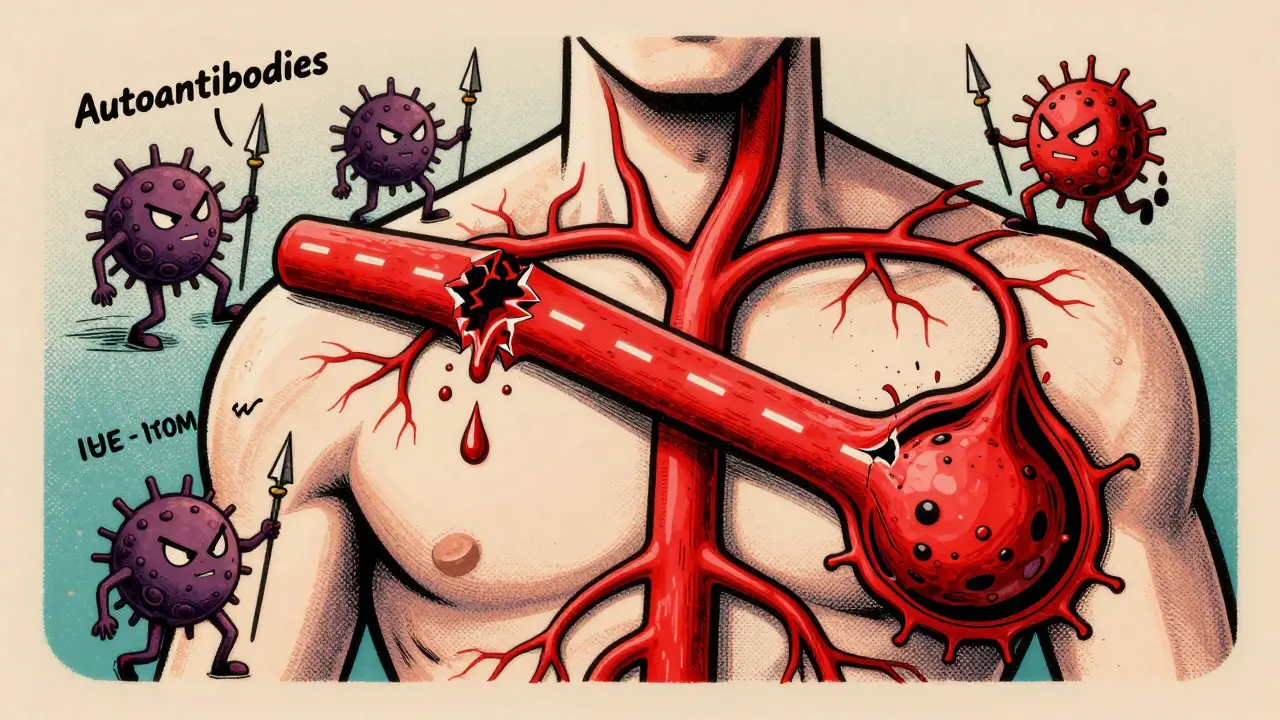
When your immune system turns on your own blood vessels, things go wrong fast. Vasculitis isn’t just a rash or a sore joint-it’s your body attacking the very pipes that carry life-giving blood to your organs. This isn’t rare. It’s just rarely recognized until it’s too late. And that’s the real danger.
Think of your blood vessels like highways. Some are big arteries, like the highway from your heart to your brain. Others are tiny roads-capillaries-that feed your skin, kidneys, or nerves. When vasculitis hits, those roads get blocked, torn, or burst. Blood can’t flow. Tissue dies. Organs fail. And it can happen in seconds-or over months-without warning.
How Vasculitis Starts: The Immune System’s Mistake
Your immune system is built to fight invaders: viruses, bacteria, toxins. But in vasculitis, it gets confused. It sees the walls of your blood vessels as threats. So it sends in white blood cells, antibodies, and inflammatory chemicals. The result? Swelling, thickening, and scarring of vessel walls. Blood flow slows. Clots form. Or worse-the vessel weakens and bulges into an aneurysm, ready to rupture.
This isn’t random. It’s autoimmune. And it’s not one disease. It’s a family of over 20 distinct conditions, grouped by which blood vessels they target. The size of the vessel tells you what you’re dealing with.
Large-Vessel Vasculitis: The Silent Attack
Large-vessel vasculitis hits the biggest arteries: the aorta, its branches, and the arteries leading to your head and arms. Two main types dominate here: giant cell arteritis a condition affecting arteries in the head, especially the temporal artery, typically in people over 50 and Takayasu arteritis a rare form that narrows the aorta and its major branches, often in young women.
Giant cell arteritis is the most common. It doesn’t just cause headaches. It can steal your vision. Sudden, painless blindness in one eye? That’s a red flag. Jaw pain when chewing? That’s another. These symptoms aren’t normal aging. They’re emergency signs. If left untreated, it can lead to stroke or permanent vision loss within days.
Doctors often start treatment with high-dose steroids right away-even before biopsy results come back. Why? Because the damage is irreversible. A biopsy of the temporal artery confirms it, but waiting for that test is risky. Steroids work fast. They calm the immune attack before it destroys your optic nerve.
Medium-Vessel Vasculitis: When the Heart and Gut Are at Risk
Medium-vessel vasculitis targets arteries feeding your muscles, skin, and organs. The two big players here are polyarteritis nodosa a systemic disease causing inflammation in medium-sized arteries, often affecting kidneys, nerves, and gastrointestinal tract and Kawasaki disease an acute childhood illness causing inflammation in medium-sized arteries, particularly the coronary arteries.
Polyarteritis nodosa is sneaky. It might start as unexplained weight loss, night sweats, or belly pain that feels like a stomach bug. But if it’s hitting your kidneys, you might not feel a thing-until your creatinine levels spike. Or if it’s in your nerves, you get numbness in your feet. By then, it’s advanced.
Kawasaki disease is different. It’s almost always in kids under five. High fever for more than five days, red eyes, swollen hands, a strawberry tongue. Left untreated, 20-25% of kids develop coronary artery aneurysms. That’s a ticking time bomb in their heart. But with IV immunoglobulin and aspirin given early, most recover fully.

Small-Vessel Vasculitis: The ANCA Connection
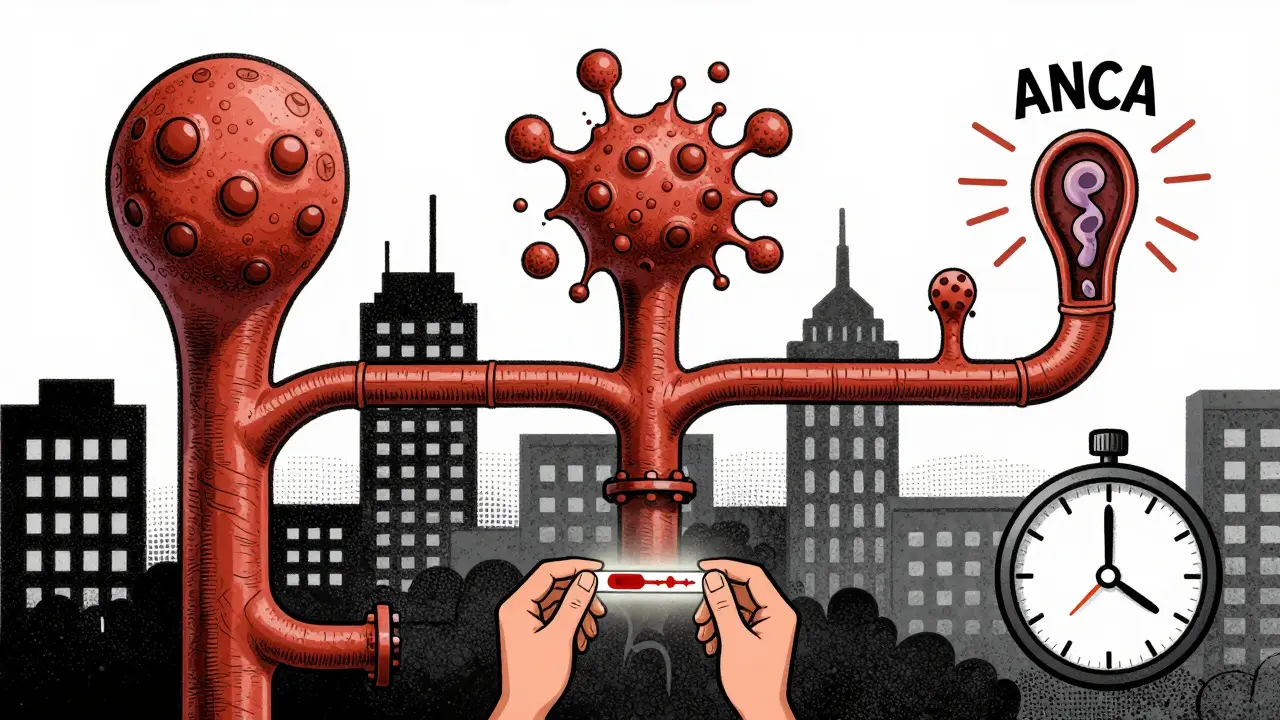
This is where things get complex-and where most patients end up in rheumatology clinics. Small-vessel vasculitis affects capillaries, venules, and small arterioles. It’s the most common type in adults. And it’s often tied to one thing: ANCA anti-neutrophil cytoplasmic antibodies, autoantibodies that attack white blood cells and trigger inflammation in small blood vessels.
There are three main ANCA-associated diseases:
- Granulomatosis with polyangiitis (GPA) formerly called Wegener’s, this condition affects the upper airways, lungs, and kidneys, often with c-ANCA targeting proteinase-3
- Microscopic polyangiitis (MPA) affects small vessels in kidneys and lungs, typically with p-ANCA targeting myeloperoxidase
- Eosinophilic granulomatosis with polyangiitis (EGPA) formerly Churg-Strauss, this involves asthma, high eosinophil counts, and nerve damage
ANCA tests aren’t perfect. But c-ANCA (targeting proteinase-3) is 80-90% specific for GPA. If you have lung nodules, sinus infections, and blood in your urine-plus a positive c-ANCA-there’s a very high chance it’s GPA.
Biopsy still rules. A kidney biopsy showing necrotizing glomerulonephritis? A lung biopsy with granulomas? That’s the gold standard. But you don’t wait for biopsy to start treatment. If the clinical picture fits, you start steroids and immunosuppressants immediately.
Diagnosis: It’s Not Just One Test
There’s no single blood test for vasculitis. Diagnosis is a puzzle. You need clinical signs, lab work, imaging, and biopsy.
Key lab clues:
- ESR over 50 mm/hr or CRP over 5 mg/dL-both tell you inflammation is raging
- Positive ANCA-helps narrow the type
- Abnormal urine test-blood or protein means kidney involvement
- High eosinophils-suggests EGPA
Imaging matters too. A CT scan can show lung nodules in GPA. An ultrasound can reveal thickened arteries in giant cell arteritis. A PET scan might show active inflammation in Takayasu arteritis.
But nothing beats tissue. A skin biopsy in someone with purple spots? If it shows leukocytoclastic vasculitis (dead white blood cells stuck around vessels), that’s a classic sign. A kidney biopsy? It can show crescent formation-meaning rapid, severe damage.
The American College of Rheumatology warns: "Vasculitis may seriously affect kidneys without many symptoms initially." That’s why routine urine tests and kidney function checks are non-negotiable-even if you only have a rash.
Treatment: Balancing Fire and Control
Treatment isn’t one-size-fits-all. It depends on the type, how bad it is, and which organs are involved.
For severe cases-like GPA, MPA, or polyarteritis nodosa with organ damage-doctors start with two things:
- High-dose steroids (prednisone 0.5-1 mg/kg/day) to shut down inflammation fast
- An immunosuppressant-either cyclophosphamide or rituximab
Rituximab has become the go-to for many because it targets B-cells-the immune cells that make ANCA. It’s less toxic than cyclophosphamide and just as effective.
Then comes maintenance. After 3-6 months of strong treatment, you switch to milder drugs like methotrexate, azathioprine, or more rituximab. You keep this up for 18-24 months. Why? Because relapse is common. Up to half of patients have a flare within five years.
Newer drugs are changing the game. Avacopan a C5a receptor inhibitor that blocks a key inflammatory signal, reducing steroid dependence in ANCA-associated vasculitis was approved in 2021. In the ADVOCATE trial, patients on avacopan had the same remission rates as those on high-dose steroids-but with 2,000 mg less steroid exposure over a year. That means fewer bone fractures, less weight gain, and lower diabetes risk.
For giant cell arteritis, tocilizumab an IL-6 inhibitor approved as an adjunct to steroids to reduce steroid dose and duration is now an option. It helps patients get off steroids faster.
And for EGPA? mepolizumab an anti-IL-5 biologic that reduces eosinophil levels and has shown 50% lower relapse rates in clinical trials is showing promise. Early results suggest it may become standard.
What You Can’t Ignore: Buerger’s Disease
Buerger’s disease (thromboangiitis obliterans) is different. It’s not autoimmune. It’s caused by smoking. It hits small and medium arteries and veins in the hands and feet. The result? Pain, ulcers, gangrene.
Here’s the hard truth: if you keep smoking, nothing works. Steroids, anti-inflammatories, surgery-all useless. Quitting tobacco isn’t a suggestion. It’s the only treatment. And if you don’t quit, you’ll lose fingers, toes, or even limbs.
Prognosis: It’s Not a Death Sentence
With treatment, 80-90% of people with ANCA-associated vasculitis go into remission. But remission isn’t cure. Relapse is part of the journey. That’s why regular follow-ups-every 3-6 months-are critical.
The Five Factor Score helps predict survival in polyarteritis nodosa:
- No major organ involvement? 95% five-year survival
- One major factor (kidney, heart, GI)? 75%
- Two or more? Drops to 50%
That’s why early diagnosis saves lives. If your kidneys are already failing, or your lungs are bleeding, your odds drop fast.
And yes-vasculitis can be fatal. If your brain doesn’t get blood, you have a stroke. If your heart’s arteries are blocked, you have a heart attack. If your kidneys shut down, you need dialysis. That’s why symptoms like sudden vision loss, chest pain, or coughing up blood need ER-level attention.
What to Watch For: Symptoms You Can’t Ignore
These aren’t "maybe it’s just a cold" signs. They’re red flags:
- Purple or red spots on legs that don’t fade when you press them
- Unexplained weight loss or night sweats
- Shortness of breath or coughing up blood
- Stomach pain that comes and goes with no clear cause
- Numbness, tingling, or weakness in hands or feet
- Sudden vision loss or jaw pain when chewing
- Fever lasting more than five days (especially in kids)
If you have even one of these-and you’re otherwise healthy-see a doctor. And if your doctor says it’s "just aging" or "stress," push back. Ask: "Could this be vasculitis?"
Most people wait 6-12 months before getting diagnosed. That delay can cost you organs. Don’t be one of them.
Can vasculitis be cured?
There’s no permanent cure, but most people can achieve long-term remission with proper treatment. The goal is to stop the immune system from attacking blood vessels. Many patients live normal lives for decades with maintenance therapy. Relapses can happen, so ongoing monitoring is essential.
Is vasculitis genetic?
No single gene causes vasculitis, but certain genetic factors may increase risk. For example, people with HLA-B27 are more likely to develop certain types. But environment-like infections or smoking-often triggers the disease in genetically susceptible people. It’s not inherited like cystic fibrosis.
Can children get vasculitis?
Yes. Kawasaki disease is the most common form in children under five. It affects coronary arteries and requires urgent treatment. Other types like IgA vasculitis (Henoch-Schönlein purpura) also occur in kids, usually after a viral infection. Pediatric cases need specialized care, especially cardiac monitoring.
Do steroids cause long-term damage?
Long-term high-dose steroids can cause bone loss, diabetes, cataracts, and weight gain. That’s why doctors now use steroid-sparing drugs like avacopan and rituximab. The goal is to use steroids only as long as needed-then switch to safer maintenance drugs. The benefits of preventing organ failure far outweigh the risks, but minimizing steroid exposure is now standard practice.
What’s the difference between vasculitis and lupus?
Lupus is a systemic autoimmune disease that can cause vasculitis as one of its features. But vasculitis can also happen on its own, without lupus. In lupus, the immune system attacks many tissues-skin, joints, kidneys. In primary vasculitis, the main target is blood vessels. They’re related, but not the same.
If you’ve been told your symptoms are "unexplained," don’t give up. Vasculitis is rare-but treatable. And if you’re experiencing even one of the warning signs, especially with persistent inflammation markers, insist on a rheumatology referral. Your life depends on catching it before your blood vessels do.
Lorna Brown
March 15, 2026 AT 06:18What struck me most is how vasculitis exposes the fragility of our biological systems. We think of blood vessels as inert pipes, but they’re dynamic, living tissues with immune surveillance built in. When that system glitches, it’s not just inflammation-it’s a civil war inside your own body. The fact that ANCA antibodies target neutrophils, which are supposed to be our first responders, is almost poetic in its tragedy. We’re literally using our own soldiers to demolish our infrastructure.
I’ve seen patients go from ‘just tired’ to dialysis in weeks. And yet, the medical community still treats this like a rare oddity. It’s not. It’s underdiagnosed because the symptoms mimic everything else: fibromyalgia, chronic fatigue, even depression. We need better screening protocols. Not just for high-risk groups, but for anyone with persistent, unexplained inflammation markers.
The real win isn’t just the drugs-it’s the shift in mindset. Steroids aren’t the hero anymore. They’re the sledgehammer. Avacopan, rituximab, mepolizumab-they’re precision tools. We’re finally moving from ‘burn it down’ to ‘calm the storm.’ That’s progress.
Rex Regum
March 15, 2026 AT 17:08Oh please. Another ‘autoimmune mystery’ dressed up like a medical breakthrough. Wake up. This isn’t some cosmic glitch-it’s the result of decades of processed food, glyphosate, and vaccines that overstimulate the immune system. They don’t want you to know that stopping sugar and gluten can reverse this. They want you hooked on biologics that cost $10,000 a month.
I read this whole thing and all I see is Big Pharma’s playbook: ‘Here’s a complex disease, here’s a complex drug, here’s your lifetime subscription.’ Meanwhile, the root cause? Ignored. Because you can’t patent a diet.
Kelsey Vonk
March 16, 2026 AT 01:15Wow. Just… wow. 🥹 This was so well written. I had no idea vasculitis could look like a simple rash or a tingling foot. I’ve been ignoring my foot numbness for months thinking it was ‘just sitting wrong.’ Now I’m terrified but also grateful. Thank you for explaining it so clearly. I’m booking a rheumatologist tomorrow. 💛
Emma Nicolls
March 16, 2026 AT 01:56i never knew vasculitis could be this serious like i thought it was just like a bad rash or something but now im scared because i had this purple spot on my leg last year and it went away and i never thought twice about it 😳 maybe i should get it checked out like now
Richard Harris
March 16, 2026 AT 23:13Interesting read. I’ve got a cousin with GPA and she’s been on rituximab for two years now. It’s been life-changing. Steroids nearly broke her-weight gain, insomnia, mood swings. Rituximab? She’s back hiking, cooking, sleeping through the night. The science here is solid. We need more awareness-not just for patients, but for GPs. Too many write off symptoms as ‘aging’ or ‘stress.’
Kandace Bennett
March 18, 2026 AT 19:51As an American, I’m proud to say our medical system is leading the world in vasculitis treatment. 🇺🇸 Avacopan? Developed right here. Rituximab? FDA-approved faster than anywhere else. Meanwhile, other countries are still stuck on prednisone and hoping for the best. Honestly, if you’re not in the U.S., you’re getting second-tier care. Don’t get me wrong-I love global medicine, but let’s be real: innovation happens here.
Also, if you’re not getting a biopsy? You’re not getting real care. Period. 🧬
Tim Schulz
March 19, 2026 AT 00:50Oh wow, so now we’re giving people anti-steroid drugs to fix the side effects of the drugs we gave them to fix the disease? 🤦♂️ What a beautiful spiral of pharmaceutical innovation. Next up: a drug to undo the side effects of the drug that undoes the side effects of the original drug. I’m already on the waiting list for ‘Avacopan2: Now With 20% More Avoidance!’
Also, ‘if you keep smoking, nothing works’-yeah, genius. Who knew? 🤡
Jinesh Jain
March 19, 2026 AT 20:43Very informative. In India, we don’t have access to these advanced drugs like avacopan or rituximab in most rural areas. Steroids are still the only option. Many patients stop treatment because they can’t afford it. The real issue isn’t diagnosis-it’s access. We need global equity in autoimmune care, not just innovation.
Emma Deasy
March 21, 2026 AT 03:58It is, without a doubt, a profound and chilling revelation that the human body-this exquisite, finely tuned organism-can, in its most vulnerable moments, become its own worst enemy. The notion that the very conduits responsible for sustaining life may be targeted, eroded, and obliterated by an internal betrayal of the immune system, is not merely medical-it is metaphysical. One cannot help but contemplate the fragility of biological order in the face of autoimmune chaos. The elegance of the ANCA hypothesis, the precision of the biopsy, the gravity of the Five Factor Score-each is a testament to the noble, arduous pursuit of understanding the invisible war waged within us. We are not merely treating disease; we are deciphering the language of self-destruction.
tamilan Nadar
March 21, 2026 AT 04:46My uncle had Takayasu. He was 28. No symptoms until his arm went cold. Now he’s on meds and fine. But in Tamil Nadu, doctors didn’t know what it was. Took 18 months. This post should be translated. Many don’t even know vasculitis exists here.
Adam M
March 22, 2026 AT 16:13Stop smoking. Get tested. Don’t wait.