Generic Drug Savings Estimator
Your Potential Savings
You've probably stood at the pharmacy counter and had the pharmacist ask, "Do you want the generic version?" It's a common moment that often triggers a quick internal debate. Is the cheaper version actually as good? Why does the pill look like a different color? Does the label mean something different? While the price tag might make you suspicious, the science behind generic vs brand name drugs is remarkably consistent. Most of the time, you're getting the exact same medical benefit, just without the expensive marketing budget.
The Core Difference: What Actually Changes?
To understand why generics are cheaper, we first have to look at what stays the same. When the U.S. Food and Drug Administration (or FDA) approves a generic, they aren't asking the company to reinvent the wheel. Instead, the generic must be a pharmaceutical equivalent. This means it has the same active ingredient, dosage, strength, and route of administration as the original.
So, where is the difference? It mostly comes down to the "inactive ingredients"-the fillers, binders, and coloring agents known as excipients. These don't treat the illness, but they hold the pill together or make it easier to swallow. Because of trademark laws, a generic drug cannot look exactly like the brand-name version. This is why your blood pressure medication might be a white round pill from one manufacturer and a pale yellow oval from another, even though the chemistry doing the work is identical.
| Feature | Brand Name Drug | Generic Equivalent |
|---|---|---|
| Active Ingredient | Proprietary Formula | Identical API |
| Inactive Ingredients | Standardized | May vary by manufacturer |
| Appearance | Trademarked shape/color | Must differ from brand |
| FDA Approval Path | New Drug Application (NDA) | Abbreviated New Drug Application (ANDA) |
| Cost | High (covers R&D) | Low (competitive market) |
What is Therapeutic Equivalence?
You'll often hear the term "therapeutic equivalence." In plain English, this means that if you take the generic, your body will react to it in the same way it would to the brand name. To prove this, the FDA requires Bioequivalence, which is the study of how a drug is absorbed and how much reaches the bloodstream.
Specifically, the FDA looks at the pharmacokinetic profile-measuring the maximum concentration (Cmax) and the area under the curve (AUC) in healthy volunteers. A generic must generally fall within 80% to 125% of the brand name's performance. This might sound like a wide gap, but in reality, this range is often tighter than the variation between two different batches of the same brand-name drug. Whether it's treating high cholesterol with atorvastatin or managing blood pressure, the clinical outcome is virtually the same.
If you want to verify if a drug is truly equivalent, the FDA maintains the Orange Book, which is the official publication listing all approved drug products and their therapeutic equivalence ratings. If a generic is rated "A," it is considered therapeutically equivalent and can be substituted without a new prescription in most states.
Decoding the Label Differences
The labels are where the most obvious changes happen. A brand-name drug uses a proprietary name-like Prilosec-which is essentially a brand identity created by a marketing team. A generic label skips the fancy name and lists the chemical name of the active ingredient, such as omeprazole.
Despite the name difference, the FDA requires that the generic's labeling mirrors the brand's regarding the most critical information. This includes:
- Indications (what the drug is used for)
- Dosage and administration instructions
- Contraindications (who should not take it)
- Warnings and potential adverse reactions
This ensures that your doctor and pharmacist have the same safety information regardless of which version you choose. The only real "mystery" on a generic label is the manufacturer's name, as different companies may produce the same generic version of a drug.
The Massive Cost Gap: Why is it So Cheap?
It's easy to assume that a lower price means lower quality, but in the pharmaceutical world, it's the opposite. The brand-name company spends billions on research, clinical trials, and marketing to get a drug to market. Once the patent expires, other companies can enter the market using the Hatch-Waxman Act framework, which allows them to skip the expensive initial trials and go straight to proving the drug is equivalent.
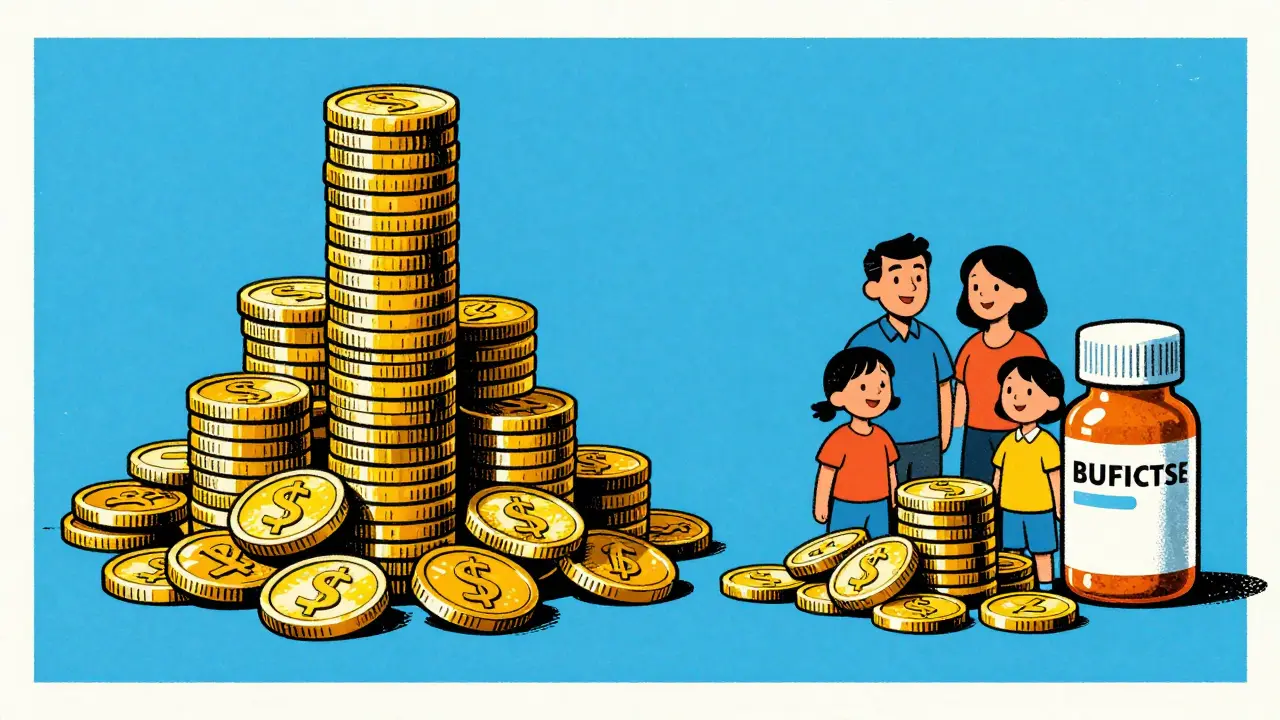
The result is a price drop that is often staggering. For example, some brand-name statins have been priced at over $300 per month, while the generic version at a big-box pharmacy can cost as little as $4. This isn't just a convenience; it's a matter of health. When medications are affordable, patients are far more likely to stick to their treatment plans, which reduces hospitalizations and long-term complications.
Are There Any Exceptions?
While generics are great for most people, there are a few cases where you need to be more careful. These are called Narrow Therapeutic Index (NTI) drugs. These are medications where a tiny change in the amount of drug in your blood can be the difference between a dose that works and one that is toxic or ineffective.
Common examples include:
- Warfarin (blood thinner)
- Levothyroxine (thyroid hormone)
- Phenytoin (anti-seizure medication)
If you are taking an NTI drug, your doctor might insist on a specific brand, or they may monitor your blood levels more closely if you switch manufacturers. It's not that the generic isn't safe; it's that your body is extremely sensitive to even the smallest variations in how these specific chemicals are absorbed.
How Substitution Actually Works
In almost every U.S. state, pharmacists have the authority to automatically substitute a brand-name drug with a generic unless your doctor explicitly writes "Dispense as Written" (DAW) on the prescription. This is designed to save the patient money without requiring a second trip to the doctor for a new script.
If you're uncomfortable with a switch, you can always ask your pharmacist for the "A-rated" generic. However, keep in mind that for some complex medications, like certain insulins or monoclonal antibodies, true generics aren't available. Instead, we use Biosimilars. Because these are made from living cells rather than a simple chemical formula, they aren't "identical" but are "highly similar" and have the same clinical effect.
Do generic drugs take longer to work than brand names?
No. Because the FDA requires bioequivalence, the rate at which the active ingredient is absorbed into your bloodstream must be nearly identical to the brand-name version. You should feel the effects at the same time.
Why does my generic pill look different every time I refill it?
This happens because your pharmacy may buy from different generic manufacturers based on cost or availability. Since each manufacturer uses different fillers or colors (and must avoid the brand's trademarked look), the pill's appearance can change even though the active medicine remains the same.
Is a generic drug a "copy" of the original?
Yes, in the sense that it uses the same active pharmaceutical ingredient (API) to achieve the same medical result. It is not a "knock-off" in terms of quality; it must meet the exact same FDA standards for purity and potency as the brand name.
Can I ask my doctor to only prescribe the brand name?
Yes, you can. Your doctor can mark the prescription "Dispense as Written." However, be prepared to pay the higher cost, as many insurance plans only cover the generic version or require a "prior authorization" to pay for the brand name.
Are there any risks to switching from brand to generic?
For the vast majority of people, there is no risk. The only minor risk is a reaction to a specific inactive ingredient (like a dye or filler) if you have a known allergy. For NTI drugs, the risk is a slight shift in efficacy, which is why those patients require closer monitoring.
Final Tips for Navigating Your Prescriptions
If you're looking to save money without risking your health, start by checking the Orange Book or asking your pharmacist if the generic is "A-rated." If you're on a high-sensitivity medication like levothyroxine, try to stick with the same manufacturer each time you refill to keep your levels steady.
If you're curious about your options, don't be afraid to ask your pharmacist, "Which generic manufacturer do you use for this drug?" They can often tell you if they have a consistent source. Ultimately, the switch to generics is one of the easiest ways to lower your healthcare spending without sacrificing the quality of your care.