
FDA Drug Label Section Finder
This interactive tool helps you understand the critical sections of FDA-approved drug labels. Select a section to learn what information it contains and why it's important for safe medication use.
Section Information
Select a section above to learn about its contents and importance for safe medication use.
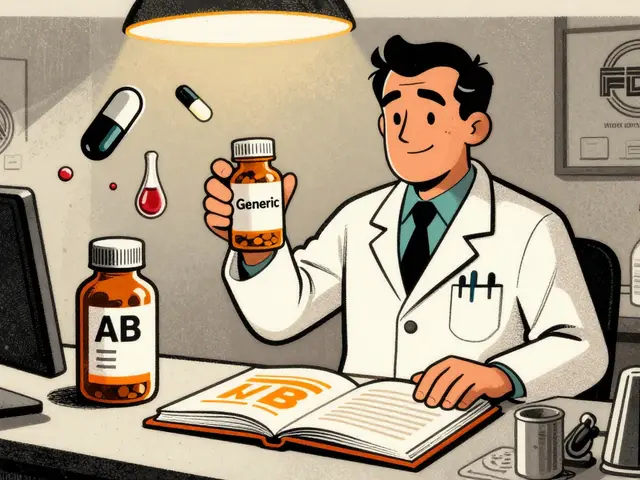
Every time you or someone you care about takes a prescription drug, there’s a detailed label behind it that tells doctors, pharmacists, and patients exactly how to use it safely. But that label isn’t just a small piece of paper tucked into the box. It’s a complex, highly regulated document called the United States Prescribing Information (USPI), and it’s structured in a very specific way. If you don’t know how to read it, you might miss critical warnings, wrong dosing instructions, or dangerous interactions. The FDA doesn’t make this easy by accident-this format exists because mistakes in reading labels have cost lives.
Why This Label Matters
Before 2006, drug labels were messy. They varied by manufacturer, used inconsistent terms, and buried important safety info in paragraphs. A 2020 analysis from the NCBI Bookshelf found that over half of medication errors linked to dosing, timing, or route of administration came from unclear labeling. The FDA responded by creating the current USPI format, which is now required by law under Title 21 of the Code of Federal Regulations. This isn’t optional-it’s enforced. Companies that don’t follow the rules face misbranding charges and can be forced to pull drugs off the market.
Today, every prescription drug sold in the U.S. must have a label that follows 17 specific sections. These aren’t suggestions. They’re mandatory. The label is submitted in Structured Product Labeling (SPL) format-an XML-based system that lets computers read and pull data into electronic health records. That’s why your EHR shows accurate drug info: it’s pulling directly from the FDA’s approved label. If the label is wrong, the system gets it wrong too.
The Three Parts of the FDA Drug Label
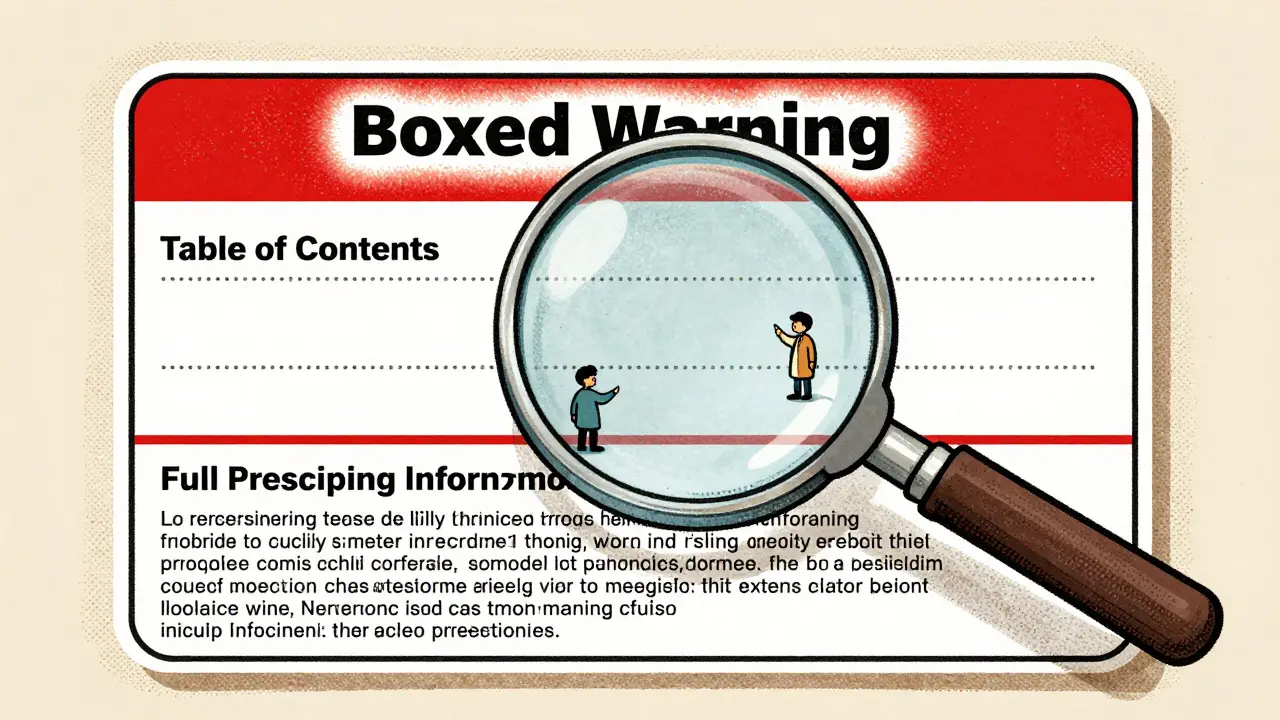
The full label has three main components: Highlights, Table of Contents, and Full Prescribing Information (FPI). Think of it like a car manual: the Highlights are the quick-start guide, the Table of Contents is the roadmap, and the FPI is the full manual.
The Highlights section is only about half a page long. It’s designed to give you the most urgent info fast: the drug’s approved uses, key dosing, boxed warnings, and major side effects. But here’s the catch-it’s incomplete. The FDA requires this section to include a disclaimer: "This is a summary of important information. Read the full prescribing information before using this drug." Many patients and even some providers stop here. That’s risky. The Highlights leave out details like drug interactions, how to adjust doses for kidney problems, or what to do in an overdose.
The Table of Contents is straightforward. It lists all 17 sections with page numbers. It’s there because the FPI can be dozens of pages long. Without it, you’re stuck scrolling or flipping through walls of text.
The Full Prescribing Information is where the real details live. It’s broken into 17 numbered sections. Each one has strict rules about what must be included. Let’s walk through the most important ones.
Section 1: Indications and Usage
This tells you exactly what the drug is approved to treat. It’s not just "for high blood pressure." It says: "For treatment of hypertension in adults, as monotherapy or in combination with other antihypertensive agents." It may also include the drug’s Established Pharmacologic Class (EPC)-like "angiotensin II receptor blocker"-to help clinicians understand how it works in the body. This section is critical. If a doctor prescribes it for something not listed here, that’s off-label use. It’s legal, but it’s not the same as FDA-approved use. You should know the difference.
Section 2: Dosage and Administration
This is where dosing gets real. It doesn’t just say "take one pill daily." It tells you:
- Starting dose
- Maximum daily dose
- How to adjust for kidney or liver problems
- Special instructions for elderly patients
- How to take it-with food? On empty stomach? With water?
- How long to wait before switching to another drug
In March 2024, the FDA updated guidance here to require clearer language about dose adjustments for renal and hepatic impairment. Before, some labels just said "use with caution." Now, they must say: "Reduce dose by 50% in patients with creatinine clearance below 30 mL/min." That specificity saves lives.
Section 3: Dosage Forms and Strengths
This lists every version of the drug: tablets, capsules, injections, extended-release, etc., with exact strengths. You’ll see something like: "5 mg, 10 mg, 20 mg film-coated tablets; 10 mg/5 mL oral suspension." This matters because look-alike/sound-alike drugs cause 12.7% of dispensing errors, according to the Institute for Safe Medication Practices (ISMP). If a pharmacist sees "20 mg tablet" but the patient’s label says "20 mg extended-release," they need to catch it. This section helps them.
Section 4: Contraindications
This tells you when NOT to use the drug. These are absolute no-go zones. For example: "Do not use in patients with known hypersensitivity to the active ingredient." Or: "Contraindicated in patients with severe hepatic impairment." If you ignore this, you risk serious harm-sometimes death. This section is short, but it’s non-negotiable.
Section 5: Warnings and Precautions
This is where the most serious risks live. And it includes the Boxed Warning-a black border around the top of the section. This is the FDA’s way of screaming: "Pay attention!" It’s required for drugs with life-threatening risks like liver failure, suicidal thoughts, or sudden cardiac death. For example, the Boxed Warning for fluoroquinolone antibiotics warns of tendon rupture and nerve damage. This section also covers less extreme but still critical risks: depression, electrolyte imbalances, or risk of falls in the elderly. It’s not just a list-it’s a risk assessment.
Section 6: Adverse Reactions
This section lists side effects from clinical trials, grouped by frequency:
- Very common (≥1/10)
- Common (≥1/100 to <1/10)
- Uncommon (≥1/1,000 to <1/100)
- Rare (≥1/10,000 to <1/1,000)
- Very rare (<1/10,000)
It also separates side effects from clinical trials from those reported after the drug hit the market. That’s important. Some rare but dangerous reactions only show up after thousands of people use the drug. This section helps doctors weigh risk vs. benefit. If a patient has a history of kidney stones, and the label says "hypercalcemia occurred in 3% of patients," that’s a red flag.
Section 7: Drug Interactions
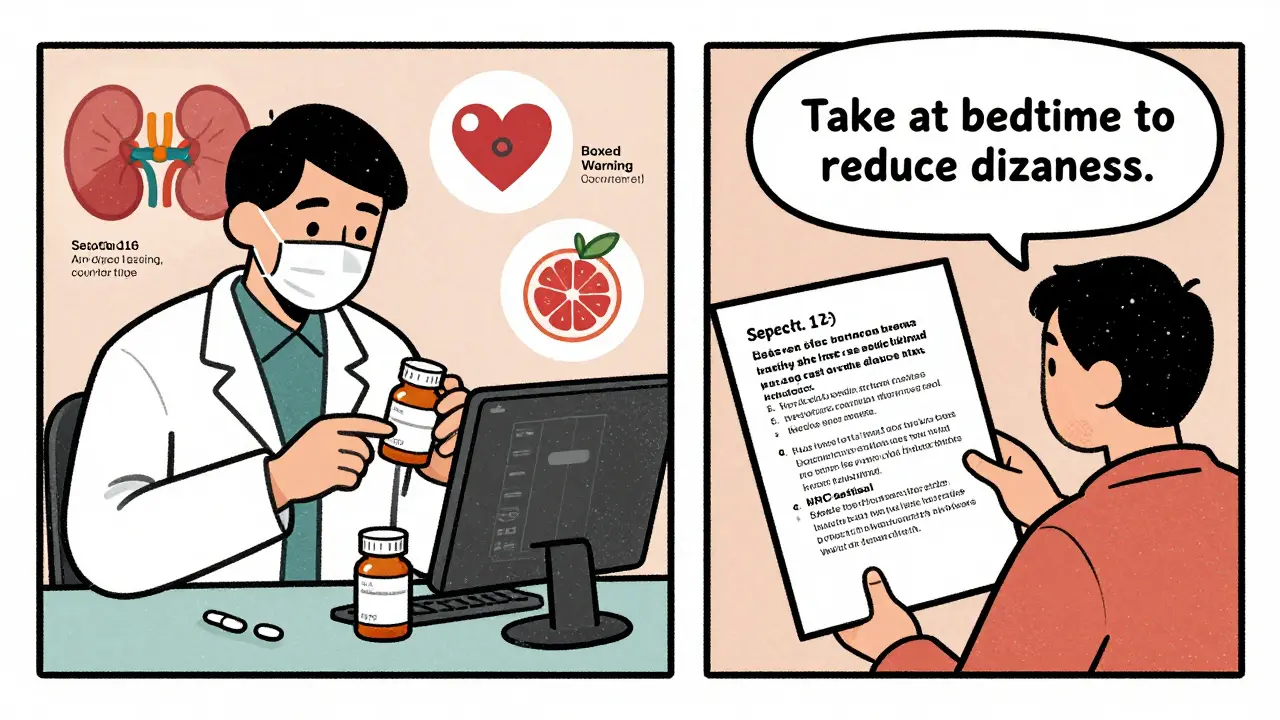
This is where things get dangerous. The label lists drugs that interact with this one-and what happens. For example: "Concomitant use with warfarin increases INR and risk of bleeding." Or: "Avoid with grapefruit juice-it increases drug levels by 300%." It also tells you what to do if you must use them together: "Monitor INR closely; reduce dose by 50%." Many doctors miss this because it’s long. But a single interaction can kill.
Section 8: Use in Specific Populations
This covers pregnancy, breastfeeding, children, and older adults. It’s not just "not studied in children." It says: "No data in pediatric patients under 12 years." Or: "Fetal risk: Category D-positive evidence of human fetal risk." For breastfeeding, it tells you if the drug passes into milk and at what levels. For seniors, it says: "Use lower starting dose due to reduced renal clearance." This section is often overlooked, but it’s essential for vulnerable patients.
Section 9: Drug Abuse and Dependence
For controlled substances, this tells you the abuse potential. Is it Schedule II? Does it cause physical dependence? What are the withdrawal symptoms? This isn’t just for opioids. Some antidepressants and sleep aids have abuse potential too. If you’re prescribing this to someone with a history of addiction, this section is your guide.
Section 10: Overdosage
What happens if someone takes too much? Symptoms? Treatment? Antidotes? This section is brief but critical. For example: "Overdose may cause QT prolongation and torsades de pointes. Treatment: ECG monitoring, IV magnesium, pacing." Without this, ER staff might not know what to do fast enough.
Section 11: Description
This gives the chemical name, structure, and molecular weight. It’s mostly for pharmacologists and researchers. Most clinicians skip it.
Section 12: Clinical Pharmacology
This explains how the drug works in the body: absorption, distribution, metabolism, excretion. It might say: "Orally absorbed in 1-2 hours; 95% bound to plasma proteins; metabolized by CYP3A4; half-life of 12 hours." This helps explain why certain interactions happen. If a patient is on a CYP3A4 inhibitor, this section tells you why the drug level might spike.
Section 13: Nonclinical Toxicology
This covers animal studies: cancer risk, genetic damage, fertility effects. It’s not about human risk-it’s about what was tested in labs. Still, if a drug caused tumors in rats at high doses, that’s something to know.
Section 14: Clinical Studies
This summarizes the trials that led to approval. It includes study design, patient numbers, outcomes, and statistical significance. It’s dense, but useful if you’re trying to understand how strong the evidence really is. For example: "In a 12-week trial of 500 patients, 68% achieved target BP vs. 42% on placebo (p<0.01)." That’s real data.
Section 15: References
Lists peer-reviewed studies cited in the label. Useful if you want to dig deeper.
Section 16: How Supplied/Storage and Handling
This gives the NDC code-a 10-digit number that breaks into three parts: labeler code, product code, and package code. It tells you how the drug is packaged: "Bottle of 30 tablets; store at 20-25°C (68-77°F)." This is critical for pharmacists to ensure they’re dispensing the right product and for pharmacies to track recalls. The FDA requires this to be exact. If the NDC is wrong, the entire supply chain breaks.
Section 17: Patient Counseling Information
This is the FDA’s script for how to talk to patients. It says exactly what to tell them: "Take this drug at bedtime to reduce dizziness." Or: "Do not stop suddenly-it may cause seizures." Yet, only 38.2% of providers use this section, according to a 2024 audit of 2,500 patient visits. That’s a missed opportunity. This section is written in plain language. Use it.
Recent Major Changes
Since 2018, every label must include a section titled "Recent Major Changes." It lists every section updated in the last six months. This is huge. Before, doctors didn’t know if a label changed. Now, they’re forced to check it. A 2024 study in the Journal of Clinical Pharmacology found this cut the time between label updates and clinical adoption by 35%. Always look here before prescribing.
How to Use This in Practice
For clinicians: Start with the Boxed Warning and Highlights. Then go to Sections 1, 2, and 7. If the patient is elderly, pregnant, or on multiple drugs, check Sections 8 and 7 again. If there’s a safety concern, read Section 6. If you’re unsure, look at Section 17-it’s written for patients, so it’s clearer.
For pharmacists: Focus on Sections 2, 3, 6, and 7. The NDC in Section 16 helps prevent look-alike errors. If a patient says, "This pill looks different," check Section 3. If they’re on a new drug, check Section 7 for interactions.
For patients: Don’t rely on the Highlights alone. Ask your provider: "Can you show me the full label?" The Patient Counseling section (Section 17) has the clearest advice. If your drug has a Boxed Warning, ask what it means for you personally.
The Future of Drug Labels
The FDA is testing interactive labels. In May 2024, they launched a pilot with 15 drugmakers to try digital formats that let users toggle between patient and provider views. By 2027, 65% of new drugs may include digital components. The goal? Reduce errors by 29%, as shown in a 2023 Johns Hopkins study. But for now, the paper label-and knowing how to read it-is still your best defense.
What’s the difference between the Highlights and the Full Prescribing Information?
The Highlights section is a condensed summary meant for quick reference, covering only the most critical information like indications, boxed warnings, and dosing. But it’s incomplete. The Full Prescribing Information contains all 17 mandatory sections with detailed data on safety, interactions, dosing adjustments, and more. The FDA requires that the Highlights include a disclaimer that it’s not a substitute for the full label. Relying only on Highlights can lead to missed risks.
What is a Boxed Warning and why is it so important?
A Boxed Warning is the FDA’s strongest safety alert. It’s a black-bordered section at the top of the Warnings and Precautions section that highlights life-threatening risks, such as liver failure, severe allergic reactions, or increased risk of suicide. It’s required by law for drugs with serious safety concerns. Ignoring a Boxed Warning can result in serious harm or death. Always read it before prescribing or taking the drug.
Why do some drug labels say "not studied in children"?
Many drugs are only tested in adults during clinical trials due to ethical and logistical challenges. Section 8 of the label will state if there’s no data for pediatric, geriatric, or pregnant populations. That doesn’t mean it’s unsafe-it means the safety and dosing hasn’t been formally established. Prescribing to these groups is off-label and requires extra caution, often based on limited evidence or expert consensus.
Can I trust the side effects listed on the label?
Yes, but with context. The Adverse Reactions section (Section 6) lists side effects seen in clinical trials, grouped by frequency. However, rare side effects may only appear after the drug is used by thousands of people. The FDA requires post-market reporting, so updates to this section happen regularly. Always check the "Recent Major Changes" section to see if new risks have been added.
How often are FDA drug labels updated?
On average, labels are updated every 14.3 months, according to FDA tracking data from 2023. Updates can include new safety warnings, dosing changes, or interaction alerts. The "Recent Major Changes" section tells you exactly what was updated in the last six months. Always review this before prescribing or dispensing a drug, especially if it’s been on the market for a while.
What to Do Next
If you’re a patient: Ask your doctor or pharmacist to walk you through the label. Bring a printed copy or show it on a tablet. Ask about the Boxed Warning and what side effects you should report right away.
If you’re a provider: Make reviewing the Full Prescribing Information part of your pre-prescribing routine. Use the "Recent Major Changes" section as a checklist. Don’t rely on memory or outdated apps.
If you’re a pharmacist: Use Section 16 to verify NDC codes before dispensing. Cross-check Section 7 for interactions with other medications the patient is taking. Use Section 17 to guide patient counseling.
Drug labels aren’t meant to be read once and forgotten. They’re living documents-and knowing how to read them could save a life.
Levi Viloria
March 3, 2026 AT 15:24Had no idea the FDA mandated this level of detail. I always thought the pill bottle info was the whole story. Turns out the real safety net is buried in XML files that EHRs pull from. Wild that this system exists to prevent human error on a structural level.
tatiana verdesoto
March 3, 2026 AT 22:43This is actually one of the most important things I’ve read all year. My mom got prescribed something last year and the pharmacist had to double-check because the label didn’t match the EHR. This explains why. Everyone should read this before their next script.
Dean Jones
March 5, 2026 AT 08:46The entire structure of the USPI is a direct response to systemic failures in medical communication. Before 2006, labels were a free-for-all. Manufacturers prioritized marketing over clarity. The FDA didn’t just standardize-they weaponized precision. Every section is a countermeasure against a documented pattern of harm. Section 5’s Boxed Warning isn’t just a warning-it’s a legal and ethical firewall. When a drug can kill you in three ways, the FDA doesn’t ask nicely. It demands visibility. And that’s why you can’t skip the FPI. The Highlights are the appetizer. The Full Prescribing Information is the meal. And if you’re eating the appetizer and calling it dinner, you’re not just uninformed-you’re endangering yourself.
John Cyrus
March 6, 2026 AT 16:39So what you’re saying is the government made drug labels harder to read so doctors can charge more for explaining them
Tobias Mösl
March 7, 2026 AT 11:50That’s not even the half of it. The SPL format is controlled by pharmaceutical companies who write the XML templates. The FDA audits it, sure-but the data is still written by the same people who profit from the drug. And if you think the EHR pulling from this is safe? Think again. I’ve seen cases where the label said ‘avoid with grapefruit’ but the EHR auto-filled ‘safe with citrus.’ Why? Because the software vendor used an outdated template. The system isn’t foolproof. It’s just more opaque.
Callum Duffy
March 8, 2026 AT 06:52It’s interesting how the structure forces clarity. No room for ambiguity. That’s rare in medicine. Most protocols are written in ‘use with caution’-which means ‘figure it out yourself.’ This is the opposite. It’s a blueprint. I wish more regulatory frameworks followed this model.
Raman Kapri
March 10, 2026 AT 01:03You are all missing the point. The FDA does not regulate drug safety. The FDA regulates pharmaceutical marketing. The label is designed to protect companies from liability, not patients. The Boxed Warning exists so they can say ‘we told you.’ The dosing instructions are written in legalese so that if someone overdoses, they can claim ‘the patient didn’t follow instructions.’ This is not safety. This is legal armor.
Ethan Zeeb
March 10, 2026 AT 13:51Actually, the real issue is that most people don’t have access to the full label. Pharmacists have it. Doctors have it. Patients get a one-page summary printed on a sticker. That’s not transparency. That’s containment. If this system is so life-saving, why isn’t the full USPI available to patients online in plain language? Because they don’t want you to ask questions.
Helen Brown
March 11, 2026 AT 07:56I think the government is using this to track us. Every time you take a pill, it's logged in the EHR. They know what you're taking. They know when you skip doses. They know if you're mixing drugs. This isn't about safety. This is about control.
Lebogang kekana
March 12, 2026 AT 02:15Man, this is why I love America. They turn life-or-death stuff into a checklist. No guessing. No guessing. You want to live? Read the damn manual. I wish my country did this. We still get pills with ‘take once daily’ and no mention of kidney function. People die here because of that. You guys got a system. Use it.