

More than 4 in 10 adults over 65 are taking five or more medications. Many of them don’t need all of them. And yet, most people never ask if they can stop. It’s not because they’re okay with the cost - it’s because they don’t know how to bring it up. A $120-a-month sleep aid you’ve been taking for years. A vitamin D pill your doctor prescribed two years ago but never checked your levels again. A daily pill for acid reflux you haven’t needed since you changed your diet. These aren’t just habits - they’re money drains. And worse, they’re risks. Deprescribing - the careful, planned process of stopping medications that aren’t helping anymore - isn’t about cutting corners. It’s about working with your doctor to keep you safer and save you hundreds, even thousands, of dollars a year.
Why You’re Paying for Medications You Don’t Need
It’s easy to assume every pill in your medicine cabinet is still necessary. But medications aren’t like a gym membership - they don’t automatically renew in your body’s favor. Over time, your health changes. Your liver processes drugs differently. Your conditions improve or stabilize. New guidelines come out. A statin you started after a heart attack might no longer be useful if your cholesterol is under control and your life expectancy is limited. A proton pump inhibitor for heartburn might be causing more harm than good after five years of use, increasing your risk of pneumonia and bone fractures. The American Academy of Family Physicians found that during a simple "brown bag" review - where patients bring all their meds to an appointment - doctors found an average of 2.3 unnecessary or harmful medications per person. That’s not a fluke. That’s the norm.What Deprescribing Really Means (And What It Doesn’t)
Deprescribing isn’t quitting your meds cold turkey. It’s not ignoring your doctor’s advice. It’s a planned, step-by-step process to safely stop drugs that no longer serve you. The goal isn’t to reduce pills for the sake of fewer pills - it’s to reduce harm and waste. Think of it like cleaning out your closet. You keep what fits, what you wear, what still works. You get rid of the things you haven’t touched in years, even if they’re still in good shape. The same logic applies to your meds. The Beers Criteria, a widely used list of potentially inappropriate medications for older adults, identifies 53 drugs that often cause more trouble than benefit. These include certain sleep aids, anticholinergics, and long-term proton pump inhibitors. But the list isn’t a rulebook - it’s a starting point for conversation. Your doctor doesn’t just look at the list. They look at you: your age, your other conditions, your goals, your budget.How to Prepare for Your Deprescribing Conversation
Don’t wait for your doctor to bring it up. Most primary care visits last less than 16 minutes. That’s not enough time to sort through a medicine cabinet full of bottles. Take control. Before your appointment:- Gather every pill, capsule, patch, and supplement - including over-the-counter drugs and herbal remedies.
- Write down why you take each one. If you don’t know, write "don’t know."
- Write down the cost of each, even if you’re on insurance. Some cost $10 a month. Others cost $150.
- Write down any side effects you’ve noticed: dizziness, confusion, dry mouth, stomach upset, falls.
Ask These Five Questions at Your Appointment
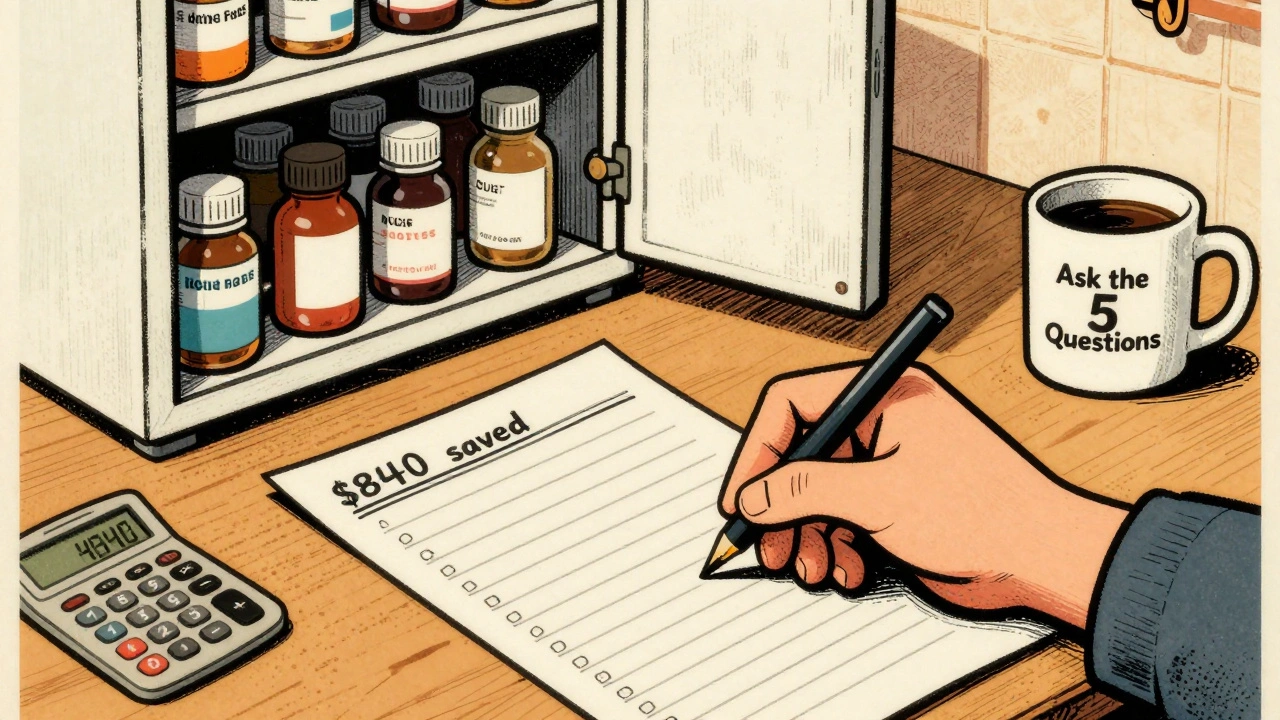
Bring your list. Then ask:- Why am I taking this medication? What condition is it for? Is it still being monitored?
- What are the benefits - and what are the risks? Is this pill preventing a heart attack, or just making me drowsy?
- Can this cause falls, memory problems, or confusion? Many meds, especially sleep aids and antihistamines, increase fall risk in older adults.
- Can I stop, reduce, or switch to something cheaper? Is there a generic? A lower dose? A non-drug alternative?
- Who should I check in with if I feel different after stopping? Don’t leave without a plan.
What Happens After You Say "Stop"?
You won’t stop everything at once. Deprescribing is slow. It’s one pill at a time. For blood pressure or antidepressants, it might take 4 to 12 weeks to taper down safely. Your doctor might ask you to track symptoms - like headaches, sleep changes, or mood - in a simple journal. You might need a follow-up visit in 2 weeks or a blood test in 6 weeks. Don’t be surprised if your doctor suggests a trial period: "Let’s cut this in half for 4 weeks and see how you feel." That’s not indecision. That’s good medicine. The key is monitoring. A 2019 study in the BMJ found that when antihypertensives were stopped too fast, 12% of patients had dangerous spikes in blood pressure. That’s why you need a plan, not just permission.Where Else to Look for Savings
Your pharmacist is your secret weapon. Most community pharmacies offer free Medication Therapy Management (MTM) services under Medicare Part D. They’ll review your whole list, spot duplicates, check for interactions, and find cheaper alternatives. One 2022 study found pharmacists identified an average of $1,200 in annual savings per patient just by suggesting generic switches or discontinuing redundant supplements. If you’re taking a $90/month vitamin D supplement but your blood levels are normal? Your pharmacist can tell you to stop. If you’re on two different acid reflux meds? They can help you drop one. And don’t forget: the Inflation Reduction Act now caps insulin at $35/month. If you’re paying more, ask your doctor for a prescription change.Real Savings, Real Stories
One woman in Ohio stopped three unnecessary medications after a brown bag review: a $120/month sleep aid, a $45/month supplement she didn’t need, and a $100/month migraine med that was being used for high blood pressure - and wasn’t even working for that. Her annual savings: $840. A Reddit user in Michigan cut a $75/month herbal remedy and a $90/month vitamin D pill after his blood test showed normal levels. He saved $1,980 in a year. Kaiser Permanente’s system-wide deprescribing program saved $1.2 million in one year - and reduced hospitalizations by 28%. For every dollar spent on structured deprescribing, health systems get $3.50 back in avoided costs. That’s not theory. That’s data.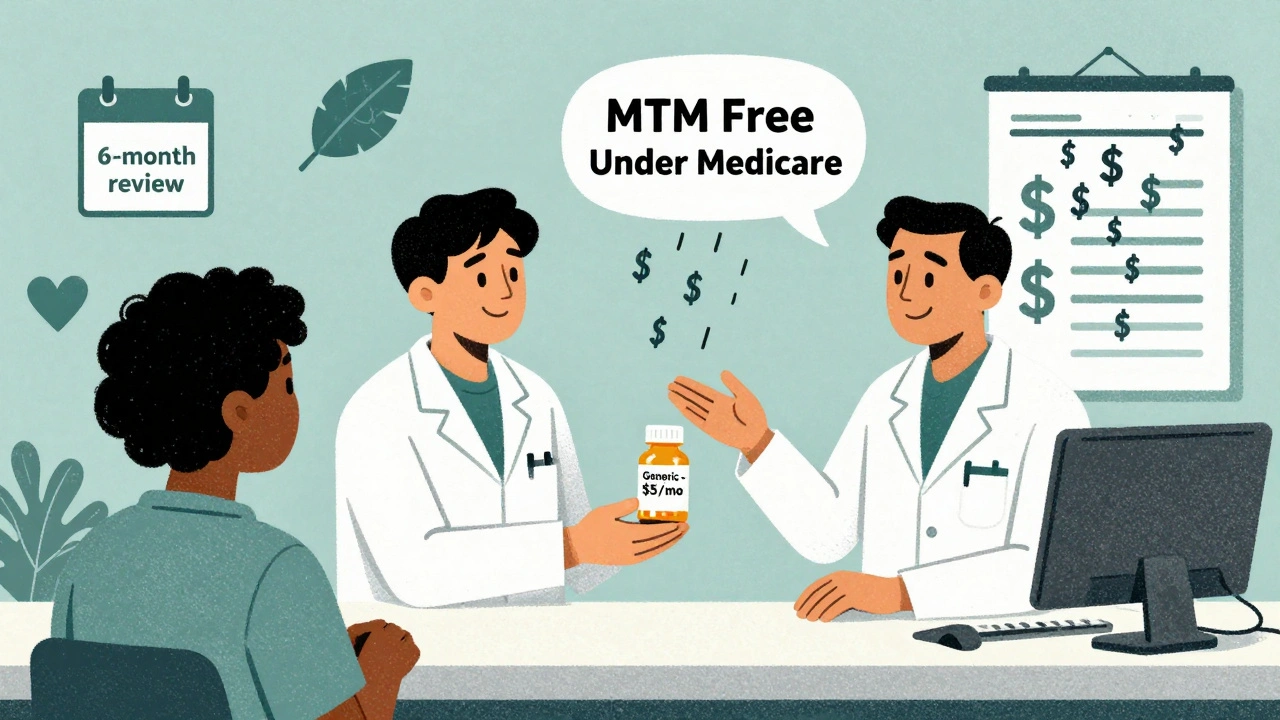
What to Watch Out For
Not everyone can safely stop meds on their own. If you try to quit without medical guidance, you’re at risk. A 2022 survey by the National Council on Aging found 18% of people who self-discontinued meds ended up in the ER or doctor’s office with side effects - costing an average of $1,200 in unexpected care. That’s the opposite of saving. Also, don’t assume your specialist knows what your primary doctor is prescribing. If you see a cardiologist, a neurologist, and a pain specialist, each might add a new pill without knowing the others. That’s how polypharmacy happens. Ask your primary doctor to be the quarterback. Request a medication reconciliation - a full review of every drug you’re taking - every time you see a new specialist.Why This Matters More Than Ever
Medication costs have risen 60% since 2014. For seniors on fixed incomes, prescriptions now eat up nearly 18% of their income. Meanwhile, 4.9 million older Americans are taking drugs that are more likely to hurt than help. The Lown Institute calls this "medication overload" - and says deprescribing is the #1 solution. It’s not just about saving money. It’s about living better. Fewer pills means fewer side effects. Fewer falls. Clearer thinking. More energy. And yes - less stress over monthly co-pays. You don’t have to accept that your meds are a financial burden. You have the right to ask if they’re still working. And you have the right to stop what’s no longer helping.Is deprescribing safe?
Yes - when done properly. Deprescribing is a planned, gradual process guided by your doctor. It’s not the same as stopping a medication suddenly. Studies show that when done with monitoring, deprescribing reduces side effects, falls, and hospital visits. The risk comes from doing it alone or without a plan.
Can I just stop taking my pills if I think they’re unnecessary?
No. Some medications, like blood pressure pills, antidepressants, or seizure drugs, can cause serious withdrawal effects if stopped suddenly. Even supplements can cause rebound symptoms. Always talk to your doctor first. A safe plan is better than a quick fix.
How do I know if a medication is no longer needed?
Ask your doctor if the original reason for the prescription still exists. Has your condition improved? Are you experiencing side effects? Has a newer, safer option come out? If you’ve been on a drug for years without a follow-up, it’s worth reviewing. Tools like the Beers Criteria help doctors identify potentially inappropriate meds for older adults.
Will my insurance cover a medication review?
Yes. Medicare Part D requires pharmacies to offer free Medication Therapy Management (MTM) to high-risk patients. You can also ask your primary care doctor for a comprehensive medication review during your annual wellness visit. Many private insurers now cover these services too.
What if my doctor says no to stopping a medication?
Ask why. If the reason is vague - "it’s just better to keep it" - ask for evidence. Request a trial: "Can we try lowering the dose for 4 weeks?" If your doctor is resistant, consider asking for a referral to a geriatrician or a pharmacist specializing in medication reviews. You have the right to a second opinion.
How often should I review my medications?
At least once a year - and every time you see a new doctor or start a new medication. If you’re on high-risk drugs (like sedatives, blood thinners, or diabetes meds), consider a review every 6 months. Your health changes. Your meds should too.

ATUL BHARDWAJ
December 2, 2025 AT 19:53Simple truth: if your grandpa takes 10 pills and feels worse, he’s not sick-he’s overdosed.
Rebecca M.
December 4, 2025 AT 05:16Oh great, another article telling us to ‘talk to our doctors’ like they’re not overworked, underpaid, and already sick of hearing ‘can I stop this?’ for the 12th time today. 😒
Lynn Steiner
December 5, 2025 AT 14:00I’ve been on 7 meds since 2018. My doctor said ‘just keep taking them’ every time I asked. Last year I had a fall. They said it was ‘aging.’ I’m 68, not a walking pharmacy. Now I’m on 4. My bank account and my balance both thank me. 💔
Alicia Marks
December 5, 2025 AT 20:17You got this. Writing down your meds? That’s huge. Your health is worth the effort. 🌱
Jack Dao
December 7, 2025 AT 07:09Most people don’t even know what ‘deprescribing’ means. They think it’s just ‘stopping meds.’ No, it’s a clinical process requiring nuance, not some TikTok health hack. If you’re not tracking symptoms or working with a pharmacist, you’re playing Russian roulette with your liver. 🧠💊
Paul Keller
December 8, 2025 AT 15:40While the intent of this article is commendable, its presentation lacks the necessary rigor to be considered a public health intervention. The anecdotal evidence presented, though emotionally compelling, does not substitute for longitudinal, peer-reviewed data on deprescribing outcomes across diverse socioeconomic strata. Furthermore, the implicit assumption that patients are capable of self-assessing medication necessity ignores cognitive decline, health literacy gaps, and the institutional inertia of prescription culture. A more robust framework would involve standardized decision trees, pharmacist-led audits, and mandatory electronic health record flags for polypharmacy risk.
Roger Leiton
December 10, 2025 AT 15:34My mom did the brown bag thing last month. We found 3 duplicates, a supplement that was just sugar pills, and a blood pressure med she hadn’t taken in 2 years. She saved $800/year. We cried. Then we high-fived. 🙌
Laura Baur
December 11, 2025 AT 18:00It’s not merely about cost-it’s about autonomy. We live in a culture that equates medical intervention with moral virtue. To stop a pill is to defy the sacred ritual of pharmaceutical compliance. But what if the true act of care is not the ingestion, but the discernment? What if healing isn’t found in the bottle, but in the quiet courage to question? You are not your prescription. You are the consciousness that chose to read this. And that, dear reader, is where true medicine begins.
Joel Deang
December 12, 2025 AT 17:05my pharma said my vit d was fine and i was paying 90 a month for it?? i was like wtf?? stopped it and now i just get sun and save $1k. also, i spell weird sorry 😅
dave nevogt
December 13, 2025 AT 14:01I’ve watched my father go from 11 pills a day to 4. It wasn’t easy. He was terrified. We did it slowly-over months. He didn’t feel ‘better’ right away. But he stopped falling. He slept better. He remembered my daughter’s name again. I think we forget that medicine isn’t just about fixing things-it’s about letting go of what’s no longer serving us. Even if it’s been part of our routine for a decade. That’s harder than taking a pill. But it’s worth it.
Steve World Shopping
December 14, 2025 AT 11:23The pharmacokinetic burden in geriatric polypharmacy is a systemic failure of primary care fragmentation. The absence of integrated medication reconciliation protocols exacerbates iatrogenic risk profiles, particularly in the context of age-related hepatic and renal clearance attenuation. A multidisciplinary approach involving clinical pharmacists, geriatricians, and EHR-driven deprescribing algorithms is not merely advisable-it is ethically imperative.