
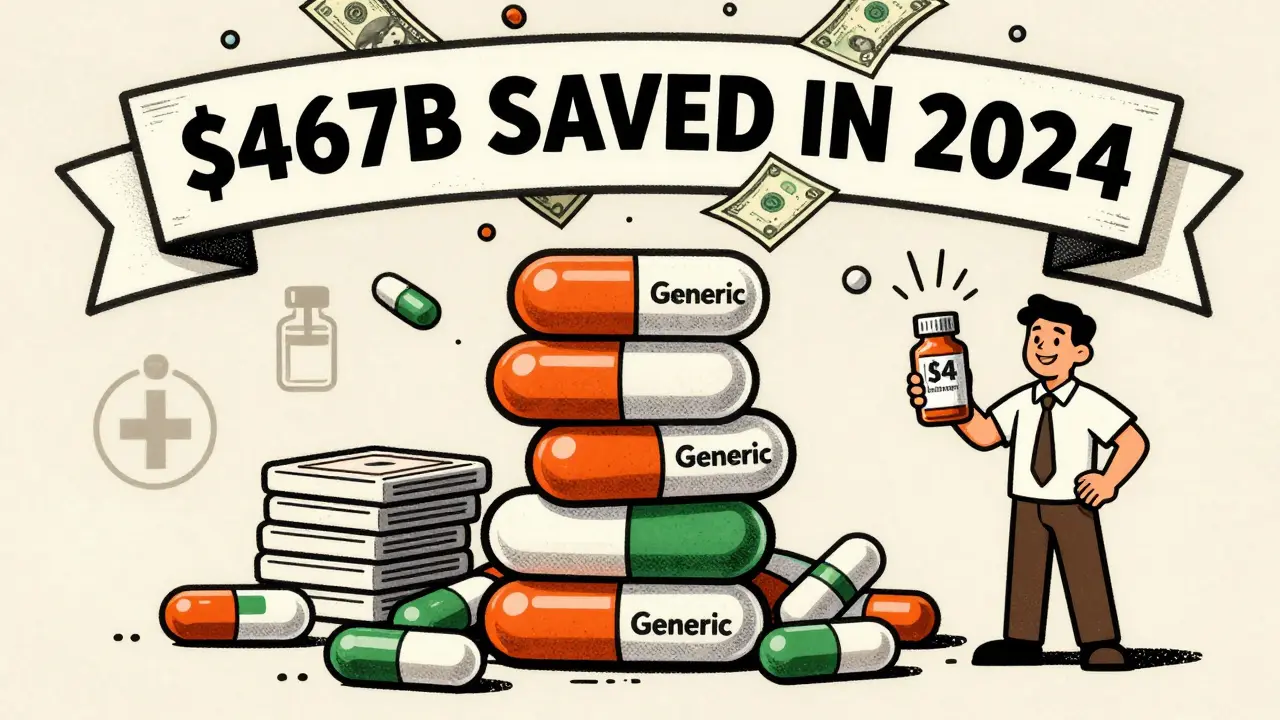
Every year, Americans fill over 3.9 billion prescriptions for generic medicines. That’s nine out of every ten prescriptions written. And yet, these generics cost just 12% of what brand-name drugs do. The result? A trillion-dollar impact on the U.S. healthcare system - $467 billion in savings in 2024 alone, and over $3.4 trillion saved since 2015. This isn’t just a minor discount. It’s the difference between people taking their medicine and skipping it because they can’t afford it.
How Generics Cut Costs So Deeply
Generic drugs aren’t cheaper because they’re low quality. They’re cheaper because they don’t need to repeat the billion-dollar clinical trials that brand-name drugs go through. Once a patent expires, other companies can make the same drug using the same active ingredients. The FDA requires them to prove they work the same way - same dose, same strength, same route of administration. That’s it. No need to reinvent the wheel. That’s why a 30-day supply of generic lisinopril for high blood pressure costs $4 at Walmart, while the brand version, Zestril, can run over $100. Same pill. Same effect. One-tenth the price. That’s the power of competition. In 2024, Americans spent $98 billion on generics but $700 billion on brand-name drugs. That’s not a typo. Nine out of ten prescriptions are generic, but they only account for one-eighth of total spending. That gap is where the savings live. And it’s growing. Generic savings jumped from $253 billion in 2016 to $467 billion in 2024 - a compound growth rate of nearly 9% per year.Biosimilars: The Next Wave of Savings
While generics copy small-molecule drugs, biosimilars do the same for complex biologic medicines - drugs made from living cells, like insulin, rheumatoid arthritis treatments, and cancer therapies. These used to cost $10,000 to $20,000 a year. Now, biosimilars are entering the market and cutting those prices by 20% to 40%. In 2024, biosimilars saved $20.2 billion in just one year. Since the first one hit the market in 2015, they’ve saved $56.2 billion total. That’s more than the entire annual budget of many U.S. states. And the best part? The biggest savings are still ahead. More biosimilars for Humira, Enbrel, and Herceptin are coming through the FDA pipeline. Experts estimate they could save another $50 billion over the next decade.The Top 10 Generics That Saved the Most
Not all generics are created equal when it comes to savings. The biggest wins come from drugs that treat common, expensive, long-term conditions. Here’s what drove the most savings in 2023:- Lisinopril - High blood pressure - $5.2 billion saved
- Atorvastatin - Cholesterol (generic Lipitor) - $7.8 billion saved
- Metformin - Diabetes - $6.1 billion saved
- Levothyroxine - Thyroid - $4.9 billion saved
- Omeprazole - Acid reflux - $4.7 billion saved
- Simvastatin - Cholesterol - $4.5 billion saved
- Amlodipine - Blood pressure - $4.3 billion saved
- Albuterol - Asthma inhalers - $3.8 billion saved
- Hydrochlorothiazide - Diuretic - $3.6 billion saved
- Metoprolol - Heart conditions - $3.4 billion saved
Why the U.S. Leads - and Why It’s Still Falling Short
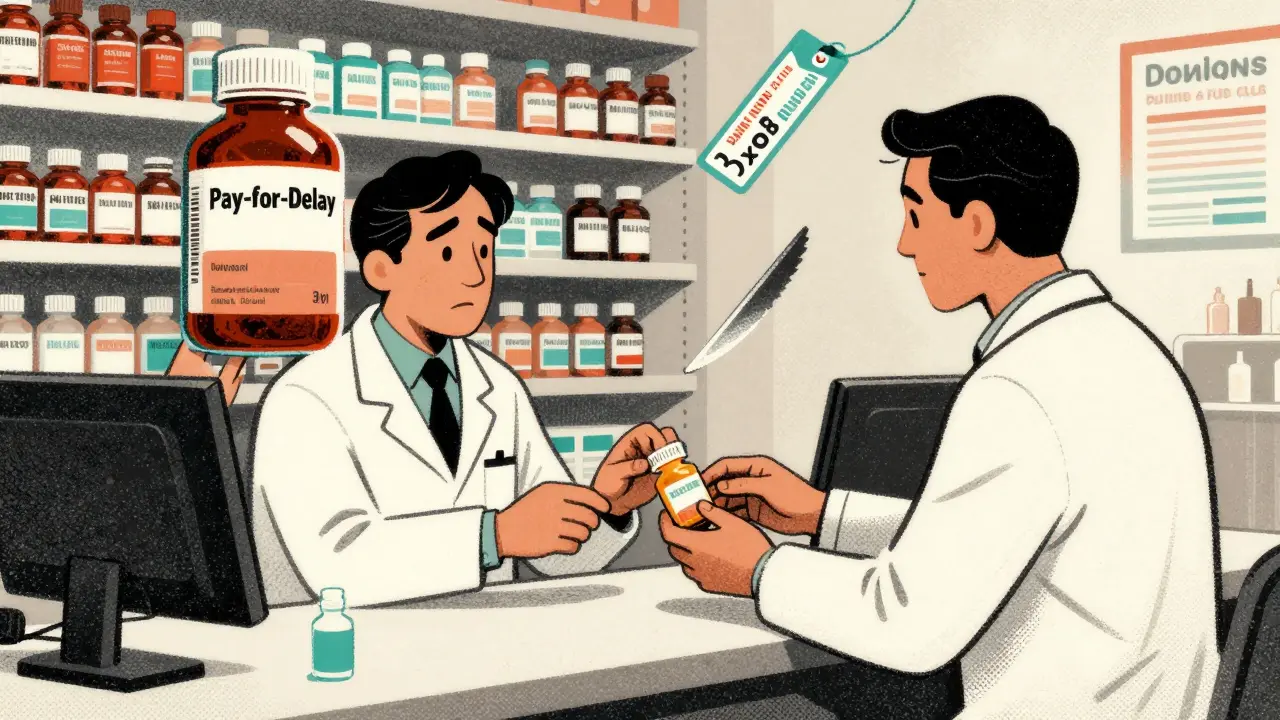
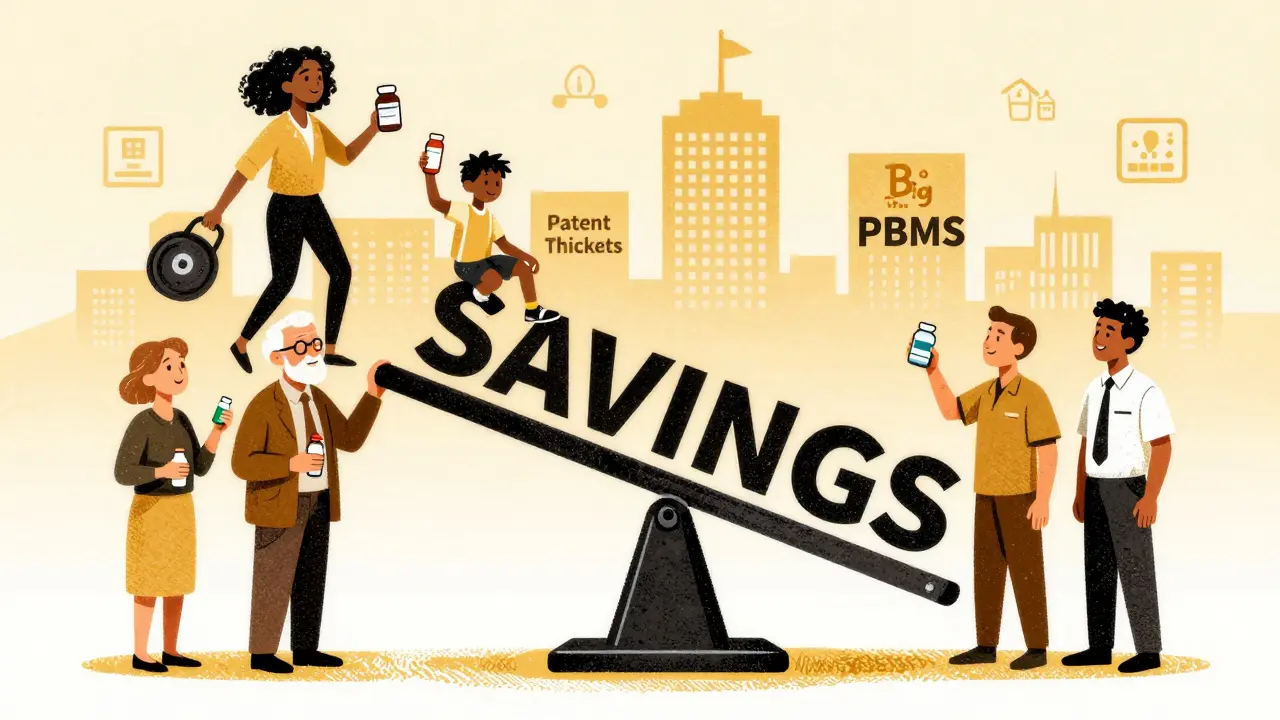
The U.S. has the highest generic use rate in the world: 90%. Most European countries hover around 60-80%. So why aren’t we saving even more? Because the system is rigged. Big pharma uses legal tricks to delay generics. One common tactic is “patent thickets” - filing dozens of minor patents on a single drug just to block competitors. A 2024 JAMA study found that just four drugs blocked by patent thickets cost the system over $3.5 billion in two years. Another trick? “Pay-for-delay.” Brand companies pay generic makers to stay off the market. In 2023, these deals cost the system nearly $12 billion - $3 billion of it paid by Medicare and Medicaid. That’s money that could’ve gone to patient care. Then there’s the pharmacy benefit managers (PBMs). These middlemen control which drugs are covered and at what price. Some push brand-name drugs even when generics are available, because they get bigger rebates from the brand makers. A 2023 survey found that 42% of patients abandoned prescriptions because of cost - but 89% of those who switched to generics said they were just as effective.What’s Holding Back the Savings?
Even when generics are approved, they don’t always reach patients. Why?- Prior authorization - Doctors now need extra paperwork to prescribe a generic, even when it’s the default option. These requests jumped 47% between 2019 and 2023.
- Formulary steering - Some Medicare Part D plans list brand drugs as preferred, even when generics exist. Patients get hit with higher copays unless they jump through hoops.
- Manufacturing shortages - In December 2024, 287 generic medications were in short supply. Many are made overseas, and supply chains are fragile.
- Market consolidation - Ten companies now control 63% of the generic market. That’s up from 51% in 2015. Less competition means less pressure to lower prices.
What This Means for You
If you’re paying for prescriptions, you’re already benefiting from generics. But you might be missing out. Ask your doctor or pharmacist: “Is there a generic version of this?” If they say no, ask why. Sometimes it’s because the brand is new. Other times, it’s because the system is working against you. Many people worry generics aren’t as strong. But 87% of users on Drugs.com rated cost as excellent or good. Only 63% rated effectiveness the same way. That gap isn’t because generics are weaker - it’s because some patients notice subtle differences in fillers or coatings. For most people, it makes zero difference. For a small number, switching back to brand is worth it. The real issue? Affordability. A 2023 survey found patients who switched to generics saved an average of $147 per month per medication. That’s over $1,700 a year. For someone on fixed income, that’s rent. That’s groceries. That’s not spending money on insulin or blood pressure pills.The Future: More Savings, But Only If We Push
The projected savings are staggering. If current trends hold, generics and biosimilars will save the U.S. healthcare system $5.1 trillion between 2025 and 2034. But that’s only if we fix the broken parts. New legislation like the Affordable Prescriptions for Patients Act - passed by the Senate HELP Committee in June 2024 - would crack down on pay-for-delay deals and patent abuse. The Congressional Budget Office says it could save $7.2 billion a year. The FDA approved over 1,100 new generics in 2024. That’s a record. And another $24 billion in drug spending is waiting to go generic in the next year. These are drugs for cancer, diabetes, heart disease - the ones people need most. The path forward is clear: more competition, fewer legal barriers, better access. Generics aren’t a luxury. They’re the backbone of affordable healthcare. And right now, they’re saving more than any other single policy in modern medicine.What You Can Do Today
- Always ask for the generic version of any prescription.
- If your insurance rejects it, appeal - they’re required to cover generics unless there’s a medical reason not to.
- Use discount apps like GoodRx or SingleCare - they often beat insurance prices on generics.
- Check if your state has a generic substitution law. If not, contact your state representative.
- Support policies that limit patent abuse and pay-for-delay deals.
Are generic drugs really as effective as brand-name drugs?
Yes. The FDA requires generics to have the same active ingredients, strength, dosage form, and route of administration as the brand-name version. They must also prove they work the same way in the body. Studies show that 90% of patients experience identical results. A few people may notice minor differences due to inactive ingredients - like fillers or coatings - but these rarely affect how well the drug works.
Why do some pharmacies push brand-name drugs over generics?
Some pharmacy benefit managers (PBMs) - the middlemen between insurers and pharmacies - get bigger rebates from brand-name drugmakers. So even when a generic is cheaper, the pharmacy may be financially incentivized to push the brand. This isn’t always the case, but it’s common enough that patients should always ask: "Is there a generic?" and compare prices using apps like GoodRx.
How much can I save by switching to a generic drug?
On average, patients save about $147 per month per medication by switching to a generic. For common drugs like lisinopril or metformin, the savings can be 90% or more - from $800 a month down to $10. Over a year, that’s $1,700 or more in out-of-pocket savings. For people on fixed incomes, this can mean the difference between taking their medicine and skipping doses.
Why aren’t all drugs available as generics?
Brand-name drugs are protected by patents, which typically last 20 years. Some companies extend this protection by filing multiple patents on minor changes - like a new coating or delivery method - a tactic called "patent thickets." These delays can push generic entry back by years. Biosimilars face even longer delays because they’re more complex to produce and regulate.
Do biosimilars save as much as generics?
Biosimilars don’t save as much per drug as generics - because biologics are far more expensive to begin with. But their impact is huge. A single biosimilar for a cancer drug can save $5,000 to $10,000 per year per patient. Since 2015, biosimilars have saved $56.2 billion total. With more entering the market, they’re expected to save over $50 billion more in the next decade.
If you're managing a chronic condition, generics are your best friend. They’re safe, effective, and drastically cheaper. Don’t assume your doctor or insurance has your best interest in mind - ask questions. Shop around. Switch when you can. The savings aren’t just numbers on a spreadsheet. They’re meals on the table, prescriptions filled, and lives kept healthy.

Meina Taiwo
December 20, 2025 AT 22:38Generics work. Period. I’ve been on metformin for 8 years. Same as the brand. Same results. No side effects. Saved me $900 a year.
Siobhan K.
December 21, 2025 AT 05:35Let’s be real-Big Pharma doesn’t care if you live or die, as long as your copay stays high. They’ve turned healthcare into a casino where the house always wins. And we’re the suckers betting on pills that cost 10x more for the exact same chemical.
Jon Paramore
December 23, 2025 AT 03:47Patent thickets are a legal loophole that’s essentially anti-competitive by design. The FTC has called them ‘strategic patenting’-a euphemism for delaying market entry to preserve monopoly rents. It’s not innovation; it’s rent-seeking dressed up as IP protection.
And PBMs? They’re the middlemen who take 15–20% of the rebate but never pass it to consumers. Their business model is predicated on obscuring price transparency. That’s why GoodRx often beats insurance.
When a drug’s patent expires, the FDA doesn’t require bioequivalence studies for every single excipient-just the active ingredient. So yes, the 0.5% difference in filler might make someone feel ‘different,’ but statistically, it’s noise.
Brian Furnell
December 24, 2025 AT 20:07Look, I’m not a doctor, but I’ve read enough JAMA and NEJM papers to know: generics are not ‘second-class’ drugs-they’re identical in pharmacokinetics, pharmacodynamics, and clinical outcomes. The only variable is cost-and sometimes, the inactive ingredients.
But here’s the kicker: the 63% market concentration among generic manufacturers? That’s not competition-it’s oligopoly. And when you have four companies controlling 60% of the supply chain for a life-saving drug like insulin, you don’t get price competition-you get price rigging.
And biosimilars? They’re the future. Biologics are complex proteins, not small molecules, so replicating them isn’t like copying a Lego set-it’s like cloning a symphony. But even at 20–40% savings, we’re talking about $10K/year drugs dropping to $6K. That’s not a drop-it’s a landslide.
And yet, insurers still steer patients toward brand names because of rebate structures. That’s not healthcare-it’s a perverse incentive system where the payer pays more to get less.
Meanwhile, in Germany, generics are automatically substituted unless the prescriber writes ‘DAW’-do not substitute. Result? 87% generic use. In the U.S.? 90% prescriptions, but only 25% of spending. Why? Because the system rewards the most expensive option.
And don’t get me started on prior authorization. It’s not clinical oversight-it’s administrative friction designed to delay, confuse, and discourage. A 47% spike since 2019? That’s not progress-that’s obstruction.
People think ‘generic’ means ‘cheap.’ It means ‘equivalent.’ The only thing cheap here is the corporate greed that keeps prices inflated.
And yes, I’ve switched every single one of my meds to generics. My pharmacist asked why I didn’t just stick with the brand. I said, ‘Because I’m not a charity for Big Pharma.’
We need legislation that bans pay-for-delay, caps PBM rebates, and mandates automatic substitution. Not because it’s nice-it’s because it’s necessary.
The trillion-dollar savings aren’t magic. They’re math. And math doesn’t lie. The system does.
Jason Silva
December 26, 2025 AT 12:23EVERYTHING IS A LIE. 🤫 The FDA is in bed with Big Pharma. 🏥 You think generics are safe? They’re made in China and India in factories that get shut down for contaminating batches with asbestos and rat poop. 💩 They test ONE batch and say ‘all good.’ That’s not science-that’s a casino. And your insulin? Probably full of synthetic fillers that cause cancer. 🚨
Why do you think they push generics? So you die quietly and don’t sue. 💀
Swapneel Mehta
December 27, 2025 AT 18:21Really appreciate this breakdown. I’m from India, and we’ve had generics for decades. We don’t even think about brand names unless we’re traveling. It’s just… medicine. I wish more people here realized it’s not about the label-it’s about the molecule.
mukesh matav
December 27, 2025 AT 21:56My dad’s on lisinopril. Switched from Zestril last year. Same pill. $4 vs $120. He’s still alive. So… yeah.
Jerry Peterson
December 29, 2025 AT 13:15As someone who’s lived in both the U.S. and Nigeria, I can tell you: the real tragedy isn’t that generics exist-it’s that Americans have to fight so hard to use them. In Lagos, you walk into a pharmacy and ask for ‘the cheap one.’ They hand you the generic. No questions. No forms. No drama. Just medicine.
Here? You need a lawyer, a spreadsheet, and a prayer.
Grace Rehman
December 31, 2025 AT 09:42Generics aren’t just cheaper-they’re a moral imperative. If we believe healthcare is a right, then the cost of medicine can’t be a barrier. The fact that we need to explain this to adults in 2025 is the real failure.
It’s not about science. It’s about power. And power doesn’t like to be questioned.
Erika Putri Aldana
January 2, 2026 AT 08:29Why do I even bother? They'll just raise the price of the generic next year anyway. 😒
Theo Newbold
January 4, 2026 AT 02:50Let’s cut the bullshit. The entire U.S. healthcare system is a Ponzi scheme. Generics save trillions? Sure. But who profits? The same conglomerates that own the patents, the PBMs, the pharmacy chains, and the insurers. It’s all one giant funnel. The ‘savings’ are just a distraction so you don’t notice the money going straight to the top.
And biosimilars? They’re not cheaper because they’re better-they’re cheaper because they’re easier to regulate. Big Pharma is already filing new patents on biosimilar delivery systems. It’s the same game. Just with bigger numbers.
We’re not fixing the system. We’re just rearranging the deck chairs on the Titanic.
Jay lawch
January 4, 2026 AT 14:44India produces 40% of the world’s generics. That’s not a coincidence. It’s a rebellion. While America pays $100 for a pill, we pay $2. Why? Because we don’t worship patents like religion. We don’t believe a corporation should own the chemistry of life. We believe medicine belongs to the people.
And you think the U.S. leads in generic use? That’s a lie. We lead in generic production. You just don’t get the benefit. Your system is designed to extract, not to heal.
Every time you buy a generic made in India, you’re stealing from Big Pharma. And I’m proud of it.
They call it ‘offshoring.’ I call it justice.
And don’t even get me started on how the U.S. government pays $200 for a drug that costs $2 to make-then lectures other countries on ‘fair pricing.’
Wake up. This isn’t economics. It’s colonialism with a prescription pad.
And yes, I’ve seen the studies. The efficacy is the same. But the moral difference? Infinite.
Stop asking why generics aren’t cheaper. Ask why your country lets them be so expensive in the first place.
And if you’re still buying brand names? You’re not just paying more-you’re paying for your own oppression.
Peggy Adams
January 6, 2026 AT 07:43So… I switched to generic atorvastatin. My cholesterol didn’t change. So I guess it works? But my stomach still hurts. Maybe it’s the fillers. Or maybe I’m just cursed.
Adrian Thompson
January 7, 2026 AT 13:16Generics are a government plot. The FDA is owned by China. The pills are laced with lithium to make Americans docile. You think you’re saving money? You’re being mind-controlled. 🧠🇨🇳
And why is everyone so okay with this? Because they’ve been programmed. Wake up.